

Messages posted by : J2SkiNews
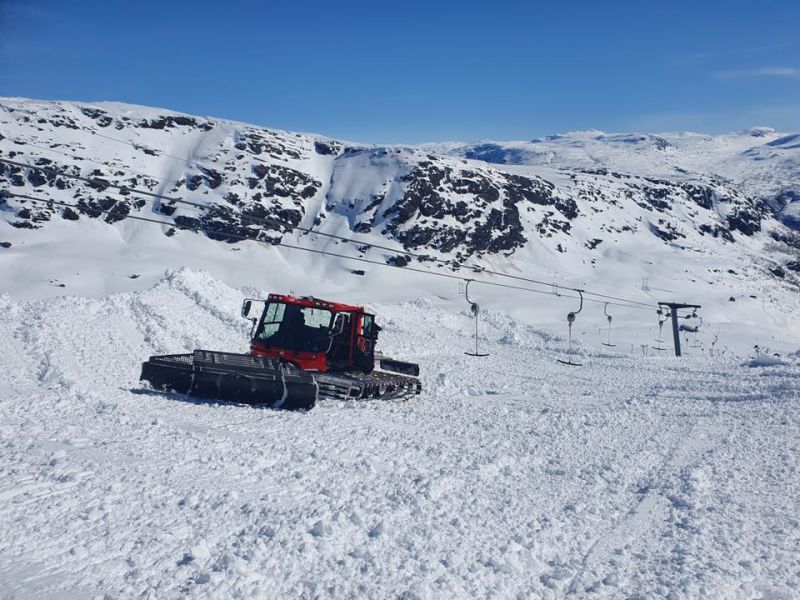
In the ever-changing and fast-moving situation around the world in terms of the ski industry's response to the COVID-19 pandemic there are some changes to report. In Norway the number of small centres that have re-opened continues to grow. Roldal, which prior to its pandemic closure five weeks ago was posting the deepest base in the world at nearly six metres is one of the latest to do so, aiming to re-open at 10am tomorrow (it's pictured above prepping slopes before re-opening). The Fonna glacier, which reports 12 metre (40 foot) base says it will open on May 1st. In the USA the small ski area of Mt Baldy in southern California has re-opened in what appears to be a unilateral decision. In an online statement it argues that as golf courses have re-opened nearby, it feels it should be able to as it will have fewer visitors, it thinks, spread over a bigger area. Conditions would normally be very much 'end of season' anyway at its location this late in April. In Austria snow ski areas are open but, as we reported last week, ski touring will be allowed from a week on Friday, May 1st, when golf courses can also open. There are also new reports that Austrian ski racers on the national squad may be allowed to return to snow for training from early May too. With the country also hoping to re-open restaurants from mid-May – if the pandemic does not spike – it seems like we may be moving towards a reopening of glacier areas sometime later this spring or in summer, although there's no official announcement of that. Elsewhere two areas remain open in northern Sweden, including "Europe's spring skiing capital" Riksgransen, they have not closed throughout the pandemic. However in Japan ski areas that had also operated throughout the pandemic finally closed at the weekend after a second, more severe spike in the pandemic there. All open areas have a range of measures in place designed to ensure they do not cause any spread of the virus, they hope. These include, amongst other thing, the usual social distancing, advance online purchase of tickets only' gloves and masks to be warn, very limited numbers on the slopes, no indoor base facilities, only one person on a lift chair or T bar at a time (unless family members). |
|
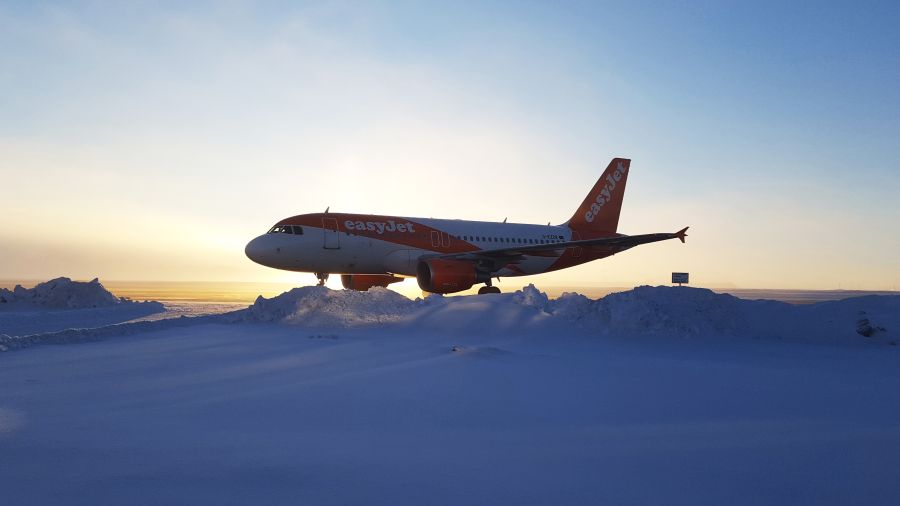
Easyjet has now put flights on sale through to 18th April 2021. Last month the company had earlier put flights for much of winter, including the February half-term holiday period, on sale far earlier than usual, and initially at a low fixed normal price. Next Easter will be one of the earliest in recent years, Sunday, 4th April 2021, meaning almost all school holidays should be over by the 18th. In recent weeks the company has also had a special offer of 99p for hold baggage items, including skis and snowboards, and this is currently reported to be still on at time of writing (22 April, 2020). Flights to Geneva are currently reported to be on sale from £23. |
|
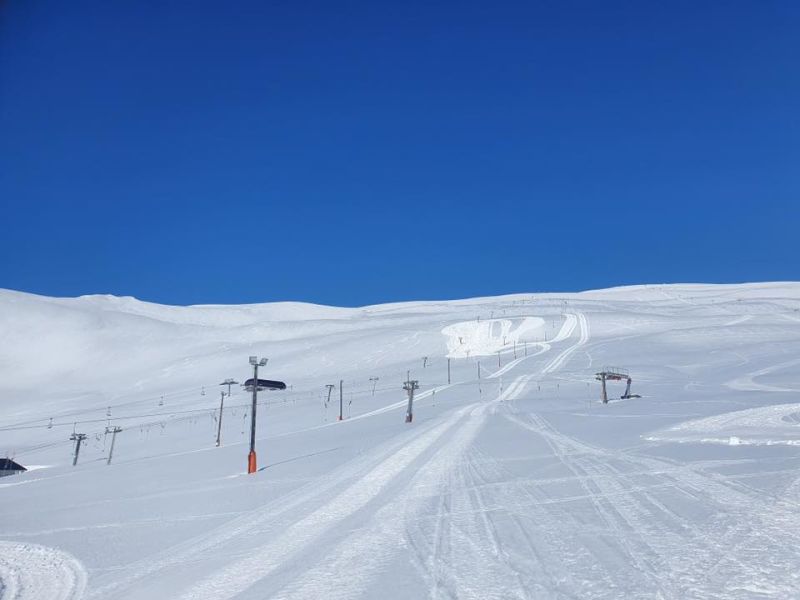
The number of ski areas open in the world is believed to be currently the lowest since the advent of high-altitude/glacier lifts more than 50 years ago. The global lockdown due to the coronaviurs COVID-19 pandemic has led to the closure of almost all ski areas around the planet. However two countries did not make ski area closure compulsory and several dozen ski areas in Japan and Sweden were still operating until last weekend. But a second and more severe outbreak of the virus in Japan, which thought it had it under control in March, has now led to, it is believed, all of the country's ski areas closing ion the past few days, rather than several dozen of them operating in to May as they usually do. This leaves just two ski areas open in the far north of Sweden, Bjorkliden and Riksgransen, up in the Arctic Circle, where local medical authorised have decided it is within safety parameters for them to keep operating at present. But there are now several other areas open in Scandinavia and the number is growing. Norway has eased its lockdown after a month and small communities are able to re-open small ski areas if local medical authorities and municipalities agree. It is being decided on an area by area basis. A number of small areas have re-opened under strict restrictions, with the Al municipality among the first to do so, a week ago. Roldal, which before the lockdown in mid-March, was posting the deepest base in the world at nearly six metres (20 feet) says it will re-open on Thursday. Norway's Fonna glacier, which is reporting a 12 metre (40 feet) base of snow, will open for its summer skiing season May 1st next week. China also eased its two-month long lockdown in late-March and a number of ski areas re-opened there under strict restrictions. However it is unclear if any are still operating in late April. The same is true for the Czech Republic where restrictions were eased a fortnight ago and one centre re-opened there last week, but it is unclear if it is still open as the weather has warmed up. The number of ski areas open today in the world is probably in single-figures however and may be as low as five. These areas are open for locally-based skiers. Normally the lowest number of ski areas open in the world gets close to single figures in the latter half of May each year when most northern hemisphere resorts have closed and no southern hemisphere areas have opened, whilst the majority of summer glacier areas in the northern hemisphere have not yet opened for their summer ski season and take a few months of low-season rest. |
|

Billy Morgan, who took Britain's first Olympic medal for a male snowboarder, competing in the Big Air in Pyeongchang, South Korea, in 2018, has told the PA news agency that he won't be competing in Beijing in 2022. Morgan, 31, whose Olympic debut was at Sochi in 2014 and whose girlfriend is now expecting their first child this summer, said he plans to take part in some fun events, but wants to keep his rediscovered passion for snowboarding. He told the news agency he loved boarding again more since easing back on treating the sport more like a job, which he says is what's needed to maintain Olympic competition standards, and that's not the approach he wants to return to. |
|
The German-based family-run ski clothing company Schöffel have announced a range of skiwear which incorporates heating to ski trousers and ski jackets will be on sale this autumn. Heating in ski clothing is not entirely new but Schöffel say that their breakthrough is in far thinner heating elements than were previously possible, with the warmth delivered via one millimetre thin carbon nanotubes. Available in premium products the heating membrane will be located in the thigh area of ski trousers and incorporated in the shoulder area of ski jackets. The system delivers a constant temperature, the company says, and switches to stand-by automatically when the jacket isn't being worn. Schöffel say that the new tech is not just designed to keep people warm but is targeted to deliver warmth to key muscle groups which they believe will help improve skier performance and keep people skiing better for longer during their day on the slopes. The theory is that warm muscles are more powerful and ensure stability at higher travel speeds, and are less injury-prone. The system also protects against cooling during lower body temperatures with periods of less intense activity.
|
|
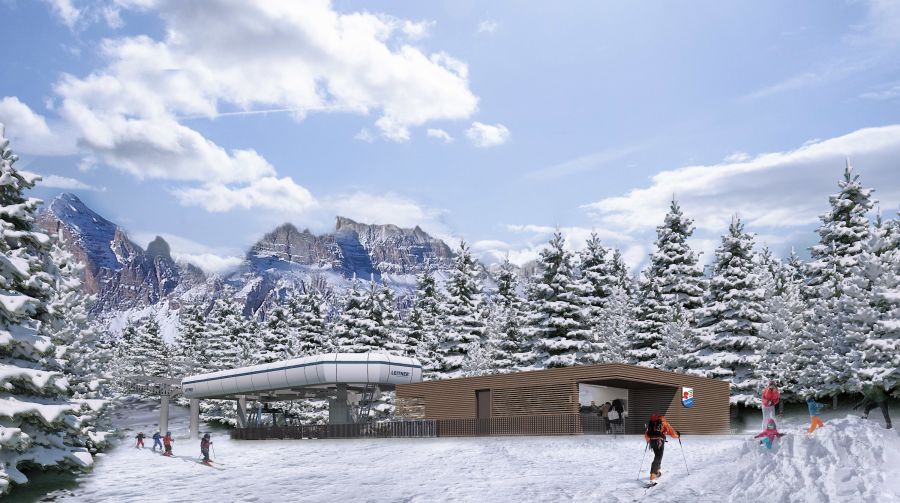
An impressive long planned lift connection between two of Cortina's ski areas in the Italian Dolomites, which was first announced as on target to be completed ahead of next winter, when the resort is due to stage the 2021 Alpine Ski World Championships, will still go ahead despite the COVID-19 issue affecting summer construction projects in ski resorts around the world. The construction the new gondola link, will, for the first time, link Cortina's ski areas of Tofane and Cinque Torri. The project, being completed by Leitner, is scheduled to start in June. The 4.5 km long journey, in 10-person cabins, aims to link the Tofane slopes close to the town, from Son dei Prade, with the runs of Cinque Torri at Bai de Dones. The lift should significantly reduce the road traffic between the two areas, which in turn will hopefully benefit the environment. Previously the connection was made by bus. Fans of skiing in the Italian Dolomites will be excited to realise that the connection will mean it will be possible, for the first time, to start the day in Cortina and travel, on skis or snowboard and lifts, onwards for up to 40km to the far side of the Sellaronda and the far end of linked valleys like Fassa and Gardena. That's because the new gondola will link to Cinque Torri from where it's possible to access the famous Hidden Valley run and then the almost-as-famous horse-pulled drag lift at the bottom to connect to the Sellaronda, then head on via ski and lifts. This will however be a one way connection, with a shuttle bus required back from the Sellaronda to Cinque Torri, as there's no lifts back up the Hidden Valley run. Early indications are, if you accept a one-way lift connection and a key actual horse-powered drag-lift – that the amount of linked terrain is very close to that of the world's largest ski area, the 3 Valleys in France, although there's no official measure of the size of the Italian area. Leitner Ropeways, who are building the new lift, are targeting completing the project by the end of 2020 or in early January 2021, so that the gondola can play its part in Cortina 2021, the Alpine Ski World Championships, the following month.
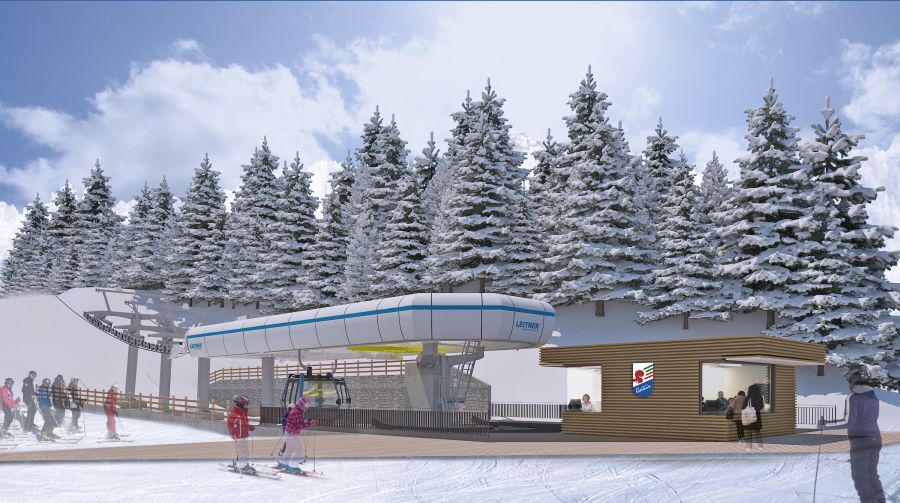
(Photos credit Leitner Ropeways) |
|
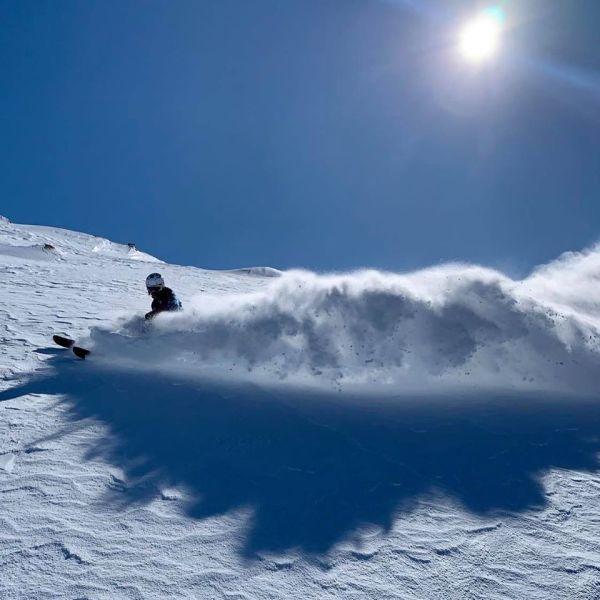
Riksgränsen ski area in northern Sweden, which is so far still open, has reached a 5.8 metre (over 19 feet) base depth after more heavy snowfall over the past few weeks. Most years somewhere in the world reaches at least a six-metre (20 foot) snow depth by the end of winter but this year nowhere had posted more than a 5.5 metre base before resorts were forced to close due to the coronavirus pandemic from mid-March. The deepest bases were reported by several resorts in Washington State in the Pacific Northwest region of the USA and several ski areas in Western Norway. One of these, Roldal, is hoping to re-open next week, if given permission to by local health authorities, following a slight loosening of the Norwegian lockdown. Riksgränsen opened for the season at the end of February and was already reporting its deepest start-of-season base depth for more than 20 years at around 4 metres at that point. The resort famously offers skiing under the midnight sun from mid-May and re-opens for skiing in late June for midsummer skiing. In recent year the midsummer skiing has had to be cancelled sometimes due to a lack of snow, but that doesn't look like it will be an issue this year. Riksgränsen does not have the deepest reported base however. The Fonna Glacier in Norway reports the snow there is lying about 12 metres deep and teams have been digging out the road to the summer ski centre for the past month. The centre is not open yet but may now be able to open this year following a relaxation in Norwegian pandemic lockdown rules last week. This has allowed some Norwegian ski areas to reopen when approved to do so by the local healthcare providers. The small Gassan summer ski area which has recently opened in Japan for its 2020 season is also reporting a nine-metre (30 feet) base. |
|
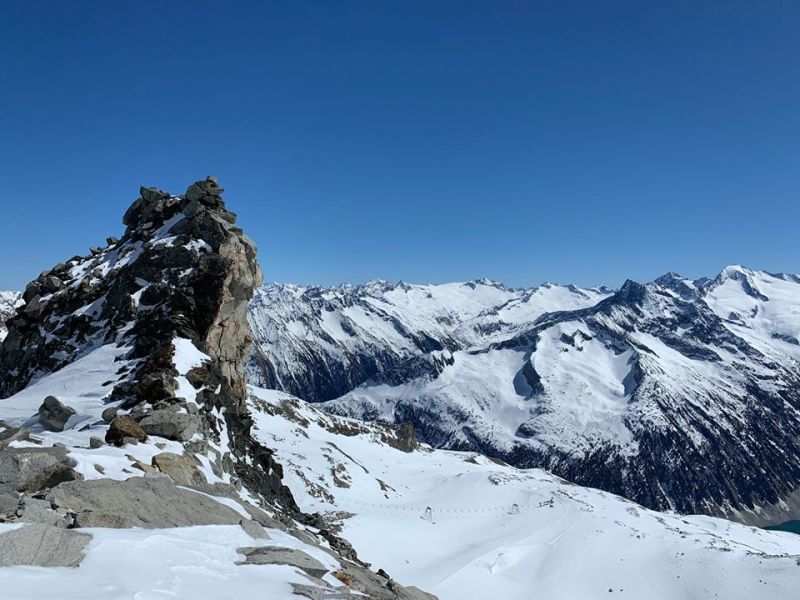
Austria has announced that a number of sporting activities will be permitted to resume from 1st May as it continues to announce relaxations in its lockdown. Although a number of the country's best known ski resorts are currently still in strict quarantine having been identified as ';hotspots' for the spread of the virus around Europe and even further afield in March, the country itself has reported fewer cases and far fewer deaths, than many of Europe's other leading ski nations. Today the country's Vice Chancellor, who is also the Sports Minister, Werner Kogler, announced a wide number of non-team sports will be able to resume in Austria from 1st May, so long as they can be practiced with social distancing. Tennis, golf, horse riding and athletics will be able to resume operations. Asked at a press conference whether ski touring would also be allowed, Vice Chancellor Kogler said "yes", but urged anyone doing so to stick to "something easy" to avoid accidents. Ski touring or back country skiing has become more popular than usual during the lockdown but is also frowned upon in most countries due to the risks of injury and likely requirement of rescue and medical resources that should be concentrated on the fight against the virus. The practice is effectively currently illegal in France and Italy and illegal or regarded as very irresponsible in most other ski nations. It is unclear as yet whether the country's glacier ski areas may be able to reopen soon. Around four ski areas are normally open in May, June and later in the summer in Austria and several say they'll re-open when permitted and its considered safe to do so. There is no suggestion that skiers outside Austria should attempt to travel there at the present time, the easing of restrictions is for Austrian citizens only. |
|