

Messages posted by : Dave Mac
|
Skied a few summer glaciers, same story, early start, fairly icy, 3 hours good snow, then down and get the swimming gear on for an afternoon by the pool.
On the other hand, some of the best Euro skiing is on Cairngorm, just now........ |
|
Haha,Ian, you have given me a great line to use. She is a Brit, but gained her ski instructor qualification in Austria, is fluent in six languages, has lived all over Europe, but currently lives in Austria, works with the Winter Olympic committee, is one of my best ski buddies, a seriously, seriously, fast skier, dead heated with me in a race down the Marbachjoch in 2min 40sec for a slightly over three and a half km run, (we beat the head instructor), can out-party anyone, and has buckets of money. Oh, and when she loses the daft brown jacket, errm, nay bad...... Apart from that, she is pretty ordinary, really. |
|
Looks to me like Andreas is in control! He is one of my best friends, but then, so is Speedie.... |
|
|
Trencher, I agree 100% with the premise of the importance of Torsional variation. I have just never been able to establish a significant potential for cause in variation. Any variation would be very significant on ski control in hard snow. (I love that. In Europe, most people talk about ice!)
Longitudinal damage is easier to think of ~ bombing down through/alongside the trees, make a mistake, and one ski takes a head on hit. The other ski suffers no damage. That, together with the other aspects that I have previously mentioned can assimilate damage to the skis in differing ways. You question the significance, and I guess this may depend upon personal circumstance. If you change skis every 2/3 seasons, there may be lesser variation. When you change every 5/15 years, the significance will increase. I have certainly witnessed a visual variation as well as physical. Hmm, thinking aloud, if the skier repeatedly turns harder on a right turn than a left, it would repeatedly stress the ski ~ in the same repeat manner, both torsionally and longitudinally. Hence the stress cycles would accumulate one way. That does not consider repeat impact damage, but it does cover repeat turn effect. Buggeroo. Who'd have thought? Which leads me to conclude that the general torsional and longitudinal deteriorisation would be be better averaged by regular L/R swaps. What you said. |
|
|
GTrencher, I agree 100% with the premise of the importance of Torsional variation. I have just never been able to establish a significant potential for cause in variation. Any variation would be very significant on ski control in hard snow. (I love that. In Europe, most people talk about ice!)
Longitudinal damage is easier to think of ~ bombing down through/alongside the trees, make a mistake, and one ski takes a head on hit. The other ski suffers no damage. That, together with the other aspects that I have previously mentioned can assimilate damage to the skis in differing ways. You question the significance, and I guess this may depend upon personal circumstance. If you change skis every 2/3 seasons, there may be lesser variation. When you change every 5/15 years, the significance will increase. I have certainly witnessed a visual variation as well as physical. Hmm, thinking aloud, if the skier repeatedly turns harder on a right turn than a left, it would repeatedly stress the ski ~ in the same repeat manner, both torsionally and longitudinally. Hence the stress cycles would accumulate one way. Which leads me to conclude that the general torsional and longitudinal deteriorisation would be be better averaged by regular L/R swaps. What you said. |
|
|
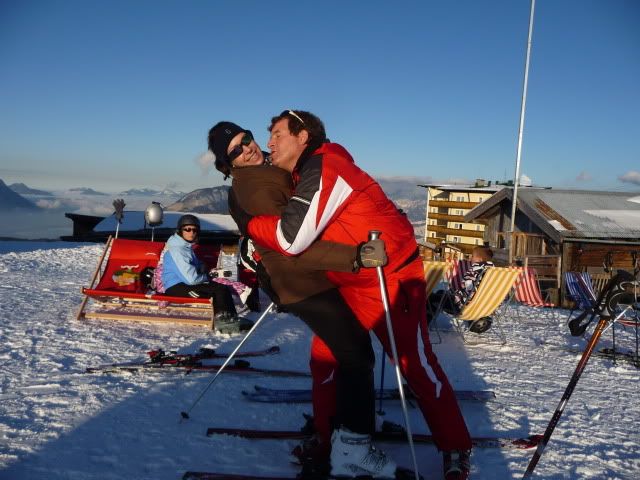
New technique in skiing, Andreas, ski instructor, and my ski buddy SpeedyRosi:
 |
|
In what way, Mackar? |
|
Not really referring to edge and base surface wear, Brooksy, more the permanent, but mainly minor changes that occur, but have an accumulative effect. If you have ever seen someone checking for inherent wear, they will push the skis together, and release, looking for the strength in the spring back. Well used skis get to the stage that they are quite "flappy". Now, you could well imagine that the change in the spring of the ski (longitudinal stiffness) is not the same in each ski, nor are changes uniform along the full length of the ski. The same is true of the ski lateral stiffness, although the changes are likely to vary between ski, they are more likely to remain uniform along the length of the ski. When you combine the lateral and longitudinal variants, the skis have developed different overall characteristics. As I previously explained, for many people they may not notice a difference. Where differences are noticible, they are mostly observed in more extreme conditions such as ice days, where you really need torsional stiffness, or when skiing very fast in soft snow, and longitudinal variants can be felt. Hiring skis makes little difference. Although it is true that most ski hire places put out good quality skis, they do not control who has skied on them! Many more variations! I did once take a pair of hire skis back, and gently suggested to the manager he might check the skis. He was sceptical, but I had him test them, and there was quite a difference between the two. So there you go, if you are having a bad day........ Oh, and:
Spot on, do some drills every day, just 10 minutes to keep you thinking, but that's a different subject. |
|