

Messages posted by : admin
Not so long now! 8) |
|
|
J2Ski Snow Report 1st September 2019
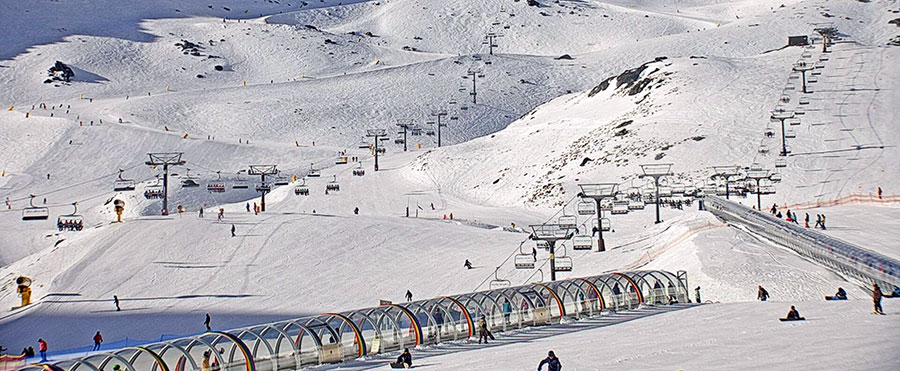
Sunshine and Snow this morning at The Remarkables, New Zealand Welcome to our guide to where to ski this September ! This Week's Snow Headlines - 1st September 2019 - Only 6 ski areas open in northern hemisphere (a historic low) due to summer heat. - Australia's season continues with more snow in August and bases reaching 2 metres. - Glaciers in Austria and Norway close as snow cover melts from ice. - New Zealand's 2019 season picks up after heavy snowfalls in August. - Austrian, French and Italian glacier areas due to open in September. - Most southern hemisphere ski areas to close by the end of September. The first of September officially marks the start of meteorological autumn, and we can start to get excited about the coming ski season in the northern hemisphere. Around half-a-dozen Austrian glaciers will open later this month, ahead of 'October-ski-fests', and the French ski season also begins at Tignes. Up in Scandinavia the first centres open too. How September 2019 will shape up in Europe though remains to be seen, it has been an exceptionally hot summer and a number of glacier ski areas are just bare ice with several currently closed that should be open because of that. In fact there are only five areas open in Europe as we start the month, a historic low. So we have our fingers crossed for a repeat of the snowy September 2018, and so far the forecasts are looking fairly promising with some snowy weather forecast up high for the first week of September, with the Austrian Alps expected to see the biggest falls (at altitude). In the southern hemisphere September is the start of spring and the wind-down month for many areas. The two commercial ski fields in southern Africa already closed for their 2019 seasons at the end of August, most of the rest in the Andes, Australia and new Zealand will shut-up-shop in the latter half of this month, although some of the major players usually soldier on in to early October. Over the past month Australia has continued its great season with more big snowfalls and good skiing weather in between, New Zealand has caught up lost ground, things have remained pretty good at most Argentinian ski areas and not so great for most Chilean areas, although there have been a few snowfalls to bring a little cheer to the mostly dry, warm 2019 winter there. In the Alpine Forecast Cooler temperatures, and a little snow at altitude, are expected next week - particularly in the eastern Alps (Austria). Longer range, temperatures look set to be a little below average for the first half of September but it's obviously (very) early days! 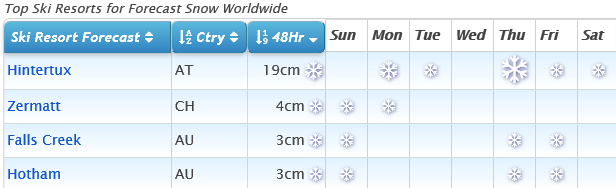
Northern hemispere ski areas edging into the snow forecasts....
EUROPEAN ALPS Austria The warm summer sun has had a damaging impact on summer skiing in Austria with only the Hintertux glacier open at present and reporting a thinning base, down to around 45cm from well over a metre at the start of last month. The snow cover has gone completely from the more southerly and smaller Molltal glacier however, as it did in August last year, leaving the glacial ice exposed and the summer ski slopes closed until more snow arrives. It had opened in June for a 10.5 month season through to early May 2020, by some measures the first to open for the 19-20 ski season, but it is currently temporarily closed. September is normally when Austria dominates the list of open areas with all or most of its eight glacier areas opening ahead of 'Octoberfests' in the first half of next month. September 2018 was a very snowy month so the resorts will be hoping for a repeat of that. The Pitztal glacier, which does have an all-weather snow-making machine to ensure cover, is due to open in the middle of the month and the Kauntertal glacier towards the end. The Stubai has not named a day as yet but has given ski ticket prices for a period from 15th September so that could be a clue. The Dachstein and Solden may open later in the month if conditions are right, only the Kitzsteinhorn above Kaprun say that they're targeting October, although they haven't got a fixed date yet either. So depending on how the sun and snow goes through September, there may be seven Austrian areas open by the end of the month, or none! France There are currently no ski areas open in France; Les 2Alpes had hoped to stay open for summer skiing to the end of August but ended up closing early in the month as it was too hot on the glacier. It was a similar story for Tignes which closed at the end of July, rather than early August, so missing its target to be open every month of the year for at least a day or two. It is aiming to get back on track at the very end of September, hoping to open for the last weekend of the month. Last year it missed that target as there was not enough snow so they'll be hoping for some good September snowfalls. No other French areas are due to open in September. Italy Italy's summer ski season at Cervinia is scheduled to draw to a close at the end of the first full weekend in September next week. It doesn't stay closed long though and is scheduled to re-open at weekends initially from October. That will leave only Passo Stelvio open in the country through September. It's upper slope base has halved from 3.5 metres when it opened for the season back in early June to 1.8 metres now and the snow has gone completely from the lower glacier leaving bare ice exposed. So there's currently about 6km of snow cover maintained by the groomers on the upper half but no home run back to base. The former Italian summer ski area of Val Senales is also due to open in September, usually in the first half of the month, conditions permitting, but again the webcam images are currently showing bare ice so the end of September at the earliest currently looks more realistic. Switzerland Swiss glacier ski areas look to be standing up the best to the summer heat, perhaps thanks in part to their few hundred metres higher elevation and orientations. Saas Fee and Zermatt are both due to stay open through September, each with 13-15km of slopes open and 1-2 metres of snow depth on the ice. Other Swiss glaciers should start opening from next month. Northern Europe The Folgefonn glacier was due to stay open until the start of September and Galdhopiggen through until the end of October but both were forced to close in July by what the manager of the latter described as unprecedented warm temperatures. It hasn't been non-stop sun, there was a brief snowfall in mid-August for some respite and the managers at Galdhopiggen has said that it does aim to re-open when it hopes things will have cooled down a little around 14/15 September but that's yet to be confirmed. North America Only the Timberline permanent snow field on Mt Hood in Oregon is open as we enter September. It actually starts it's annual calculation of snowfall on September 1st so it kind of regards then as the start of its 2019-20 ski season. 2018-19 to 321st August netted 496 inches (12.6 metres) they said but that didn't change through the summer as it has been mostly warm and dry. The centre usually closes for a period in September and October for an annual maintenance shut down in its year-round schedule. Southern Hemisphere Australia Australia has been enjoying one of its best winters in years – arguably the best of the four major southern hemisphere ski nations - with half-a-dozen major multi-day snowstorms over the past three months which have helped build bases to as deep as 2.2 metres at one centre with several others reporting snow depths of more than two metres. Those are some of the best numbers in 29 years with a metre snow depth generally regarded as a pretty good benchmark for a decent season in the country. In between the storms there have been perfect sunny days with temperatures hovering around zero. Most of the country's ski areas are fully open, or thereabouts, with the largest, Perisher, one of those reporting more than a two-metre base and up to 100 trails open. Usually the Australian ski season ends at the end of September, but it seems likely there will be some season extensions into early October with conditions as they are. New Zealand It's not been the best ski season for New Zealand but the best conditions have definitely come towards the end of the winter with some heavy snowfalls last month after an often warm, dry and even wet June and July at many areas. The snow has arrived with some fairly extreme weather at times with gale force winds a frequent problem, leading to the cancellation of the finals of the inaugural FIS World Cup competition of 2019-20 at Cardrona in late August. Snow depths on some of the club fields are now up to 3 metres, the deepest in the southern hemisphere, and the country's biggest resort, Ruapehu on the North Island, has 2.2 metres lying at its Whakapapa base. Most New Zealand ski areas stay open to early October and Ruapehu is usually the last to close at the end of next month or sometimes even staying open in to 'Snowvember' so all will be hoping for a good September to make up for ground lost earlier in the season. Chile 2019 will not be a season to look back on for most ski areas in Chile. Some of the country's famous areas like Portillo and Valle Nevado are still struggling for snow cover and their famous off piste powder has been thin on the ground, but both have 50-70% of groomed runs open despite these challenges. It's looking better further south where Nevados de Chillan has clocked up a 1-2 metre base and in contrast has had lots of snowy days and is fully open. Argentina Most ski areas in Argentina have had the better of the August snowfall (and indeed the snowfall all season) in South America. The largest area, Catedral near Barriloche has more than a metre of snow lying on upper slopes. Las Lenas, another of the country's famous resorts has had some big snowfalls at times but has stuggled to maintain decent cover, especially off piste, although it did get a good snowfall in the last few days of August. Southern Africa The 2019 season finished on schedule at Afriski in Lesotho and Tiffindell in South Africa after what both described as an unusually warm August. |
|
Snow Reports by e-mail - New Ski Resorts
Started by User in Snow Forecasts and Snow Reports, 85 Replies |
|
Snow forecasts for Kusatsu Onsen and Karuizawa are now available in your snow mail options. Enjoy! :thumbup: |
|
|
Innsbruck's well located (!) if you fancy Austria again, and you'll get the conveniences (and, probably, many accommodation options) of a good-sized city.
Bourg Saint Maurice is somewhat smaller but very well located for enough big French ski areas to keep you busy for a winter, with a direct funicular link into Les Arcs and only short road trips required to get you to La Plagne, Tignes, Val d'Isere and a whole bunch of others. If you fancy Italy, then you could do worse than looking at Aosta; nice town with a direct gondola up to Pila and good road connections to all the resorts in the Aosta Valley (and through the tunnel to Chamonix for a longer day trip or two). Do you have a preference for country or culture? |
|
|
The new airport goes by the names of either Scandinavian Mountains Airport or Sälen Trysil.
As if by magic... you can check out the nearest ski resorts and snow conditions on J2Ski's Map of Ski Areas near Sälen Trysil. We know a few of you are fans of skiing in Norway and Sweden... anyone booked to fly through here yet? |
|
|
You should have no trouble finding a hotel in January, outside the New Year week.
Unless you are looking at the first week of January, that may be because a lot of hotels still only take early bookings for complete weeks (they don't want to lose the possibility of renting out a room for a week by accepting a short stay). Also, many resort hotels will have blocks of beds reserved by tour operators that will be released if the TO fails to fill them by a certain date. Short stays will be much more available nearer the time, as hotels *will* have space to fill. January's one of the best times to ski IMHO, as the slopes are quiet and accommodation should be easy to find - at off-peak prices - pretty much anywhere. Go for it, and good luck! 8) |
|
|
J2Ski Snow Report 1st August 2019
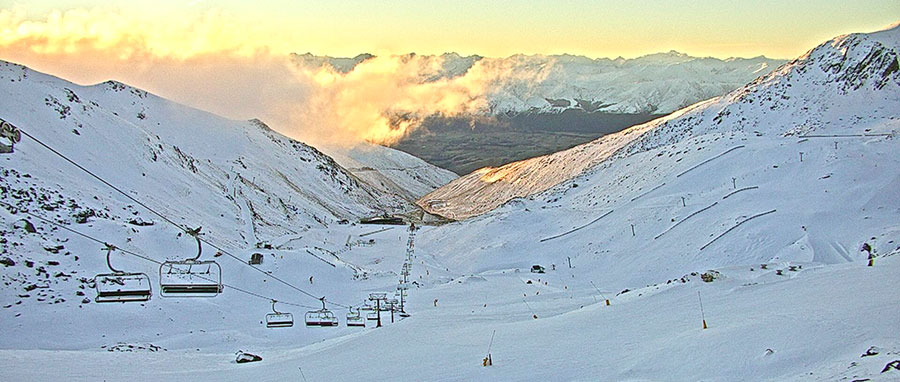
The Remarkables, New Zealand, had snow this week... Welcome to our guide to where to ski this August ! This Week's Snow Headlines - 1st August 2019 - No August skiing in Scandinavia after glacier areas end season early. - Heavy July snow in Argentina claimed to be most for 20 years brings 60cm in 48 hours. - Number of ski areas open north of equator drops to single figures as heat closes slopes. - Deepest base in southern hemisphere reaches 2 metre mark. - First of southern hemisphere ski areas to complete 2019 season will do so by end of month. - Mammoth Mountain clocks up 261 day 18-19 ski season but doesn't quite make it to August. The start of August marks the last full month of winter in the southern hemisphere and the end of summer north of the equator. It can also be one of the hottest months on glaciers in the Alps and the coldest and snowiest in mountains in Australia, New Zealand, Southern Africa and South America where it's the last full month of the ski season. 2019 is not looking much different to other years so far. If anything it has been a little hotter than usual in Europe and north America over the latter half of July. Indeed record high temperatures were reached day and night above 3000 metres in the French Alps leading Tignes to close early. Over in North America Mammoth Mountain also closed a little earlier than planned and didn't quite make it in to August as it had hoped, but it's not really much warmer than usual there; it's simply very warm. South of the equator it has been a mixed picture with Australian ski areas having a fairly consistently good winter so far with some significant snowfalls building bases and cold weather in between. New Zealand has had a more problematic first half of winter 2019 however with less snow and some warm, wet weather at times, but the start of August sees an improving picture here with more consistent, recent snowfalls. Over in South America, unusually Argentina is having a better start to the 2019 season than Chile. In fact some ski areas are close together on each side of the border in the Andes but ski areas in the east and south seem to be seeing the best of the snow and in Argentina one area has reached a 2 metre base (although it is now publishing 1.7 metres so it appears to have since dropped again!), the first in the southern hemisphere top do so this year. Finally in Southern Africa, where the three month ski season is already two-thirds over, late July saw several good natural snowfalls (which aren't common here), which, combined with snow-making, means the two commercial ski fields in the region should be operating at capacity for the final 3-4 weeks of the season, to the last weekend of August. In the Alpine Forecast The next week or so should be largely settled across the Alps, with generally clear weather and temperatures around - or a little above - seasonal averages. In the northern Alps, a period of stormy weather could follow with heavy rain (and snow at high altitudes). 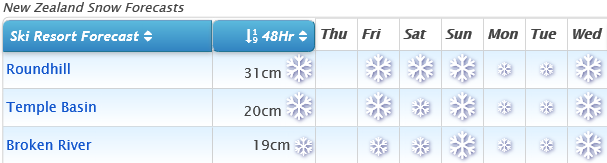
More snowfall expected for New Zealand.
EUROPEAN ALPS As mentioned above it's been hot in the high French alps with record July temperatures set, day and night, above 3000 metres in July. Daytime temps up on the glaciers hit 19C and even at 3am, when temperatures need to be below zero for snow conditions to be maintained and to stop glacier thawing, it was as high as +9C. As a result of the heat Tignes closed for snowsports on the last Sunday of July, a week earlier than planned. Les 2 Alpes, which claims Europe's largest skiable glacier, is still open and aims to stay open through to the start of September, but in recent years it too has closed temporarily and/or ended its summer ski season early because it has been too hot, and it is a little difficult to see how summer 2019 can be different unless there's a big change in the weather in August and its suddenly unseasonably cool. Tignes, where the lift company said it was concerned that crevasses could open up in the glacier below the remaining snow, says it will re-open for the last weekend of September, all being well. Six other areas are open in the Alps – two each for Austria, Italy and Switzerland. Austria In Austria it's the country's year-round centre of Hintertux and the nearly year-round Molltal glacier that are skiable in August. Hintertux reports the biggest area open but worryingly its snow depth has dropped below a metre so hopefully it will make it through until the snow starts to fall again in the autumn. Molltal says it's snow is much deeper at over two metres. Only a few miles of slopes are open here. Italy Cervinia's summer skiing on Plateau Rosa is in good shape for the time of year thanks in part to good winter and spring snowfalls building the base there. Passo Stelvio claims the deepest snow in the world at present at over 3 metres and reports all runs open. Switzerland Europe's highest slopes, above Zermatt, are open. They were closed for part of the final weekend of July by stormy weather, but on the upside that managed to bring a little fresh snowfall between heatwaves. The nearby glacier ski slopes at Saas Fee also re-opened last month for the start of the nine month season there through to April next year. Scandinavia Unfortunately the heat has got the better of the summer ski areas in Scandinavia with the two Norwegian centres that had planned to stay open through to September, instead closing in the latter half of last month. Both Folgefonn (The "Fonna Glacier") and the region's highest ski area at Galdhopiggen decided it to call it a day on their 2019 seasons early as it was too warm for the surviving snow to be very skiable. Galdhoppigen – which aims to offer skiing through to early November, says it hopes it will be able to re-open in mid-September. North America Mammoth Mountain had hoped to stay open in to August but as in Europe the heat has proved too much and it made it to the last Sunday of July, having been open for 261 days straight, but called it a day on its nearly nine month long winter 2018-19 then. So that currently leaves only one ski area open in the USA, and indeed all of North America - as there's nowhere currently open in Canada – the Timberline ski field on Mt Hood in Oregon. This is located on a "permanent snow field" (Kind of one level below a glacier) which never melts away completely (hopefully) and aims to be open about 11 months of the year, usually just closing for a few weeks in September. So far, so good, but here too temperatures are due to hit the 30s Celsius at the start of August and snow cover has been getting thin so it's not clear if the centre will be able to stay open through August. If it does there are race training pistes and a couple of terrain parks currently open daily between 7am and 2pm. Asia Japan's Gassan ski area is just about still open it seems. Regular opening of the short drag lift on the snowfield that still survives, now down to 1.5m thick from the 190 metre depth it had in April, has ended but it does operate subject to demand still at times. Southern Hemisphere Australia Australian ski slopes are in pretty good shape for August following some big July snowfalls and mostly low temperatures through the month. As a result bases have passed the metre mark at most of the country's leading areas with the biggest resort, Perisher, reporting 1.8 metres (six feet) of snow lying as we enter August. It has more than 80 runs open too, more than any other area at the present time, although some may have bigger skiable areas accessible. Of the other big Aussie ski areas most are also fully open and operating at capacity. August is the last full month of the season here with most Australian areas closing at the end of September, although Perisher usually extends its season to the start of October. New Zealand New Zealand's ski areas had a problematic start to winter 2019 with little natural snowfall and periods of warm weather. Mostly though there's not been enough precipitation of either variety and the ski areas with the most extensive snow-making systems have enjoyed the best conditions. Things are changing for the start of August though with a series of heavy snow storms moving up from the Antarctic in the last few days, and most of the country's ski areas reporting 25-35cm of fresh snow in 24 hours for the last day of July and consistently low temperatures. Chile A rather mixed picture in the Andes where we're five weeks in to winter 2019. The biggest snowfalls to date have been down in the south of the country where Nevados de Chillan is fully open, has a 165cm base (5.5 feet) and has been posting powder pictures for much of July. Things were a little less in keeping with the powdery image at resorts like Portillo and particularly Valle Nevado to the north until very recently. Portillo ended July with six inches (15cm) of fresh snow though and its slope depth ranges from 60-150cm (2- 5 feet). There's been some fresh for Valle Nevado too but it still has the lowest numbers for a leading resort in south America at 40-60cm (16-24 inches). Argentina Argentina's ski areas appear to have had the best snow conditions, overall, in South America so far this season. Catedral, the continent's largest resort by uplift, got particularly excited a few weeks ago with a 60cm (two foot) snowfall over 72 hours which it reported as the biggest for 20 years. Another area, Chapelco, was the first to report a 2 metre base in the southern hemisphere in late July, although that has now dropped a little. Generally though, conditions have been great and July ended with more fresh snow falling at most Argentinian ski areas. South Africa August is the last month of the 2019 ski season at South Africa's Tiffindell ski area. There was some fresh snow here with several falls bringing 15cm of rare natural snowfall in the latter half of July. That has all melted again now but the area is fully open thanks to snow-making and should remain so through to the end of the month. Lesotho It's the final three weeks of the 2019 season for Afriski in Lesotho too so it's good news that after some natural snowfalls coupled with cold weather to fire up its newly upgraded snow-making system, the centre is now operating at maximum capacity with its full 1km long main run open along with terrain parks. |
|
|
If buying new, I'm pretty sure Graham Bell is still the main agent through http://www.skiersedge.co.uk/. He usually has a stand at the London Ski Show / Festival / Event thing in October. I might be mis-remembering but think he occasionally has reconditioned machines for sale also. Definitely worth a quick call to ask him!
For 2nd hand, they occasionally come up on eBay at bargain prices if you're prepared to collect; I sold mine (for a bargain price :( ) on there a couple of years ago. Great machine but I no longer had room (i.e. a room!) for it. |
|