

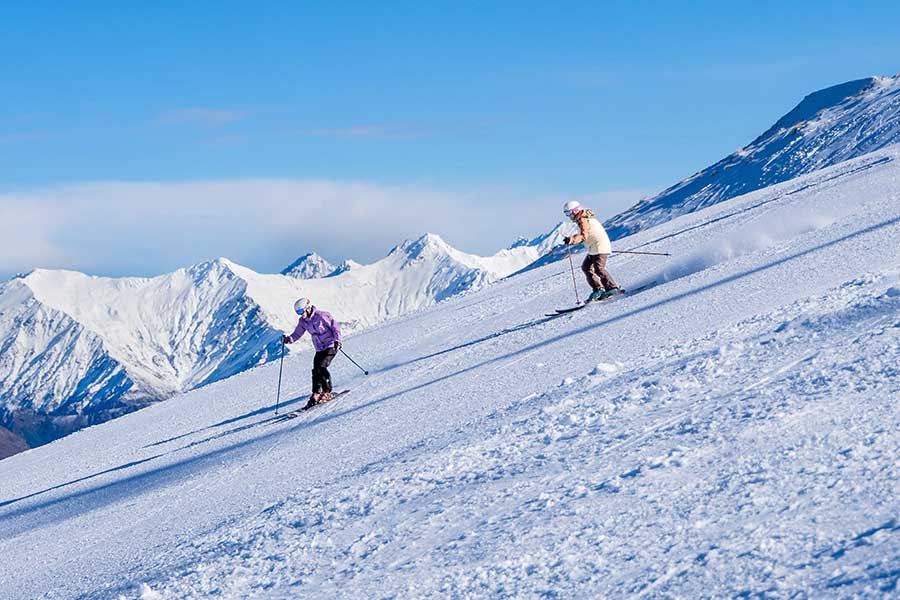
Spring skiing with fresh snow at Coronet Peak, New Zealand, this week
While Chile is posting the deepest snowpack and most open terrain in the world, Australia's 2026 season faces a rapid meltdown and early closures due to heavy rain. New Zealand continues to fare much better with nearly all of its terrain remaining open.
The Snow Headlines - September 3rd
- Chile posting (by far) deepest cover and most terrain open in the world at present.
- World's deepest reported snow depth nears 5 metres in Chile.
- Australia's 2026 season in rapid meltdown following heavy rain on thin snowpack.
- Glacier skiing resumes with marginal conditions in European Alps.
- Some snowfall reported on high terrain in The Alps.
- More snowfall turns high terrain white in North America's Northwest.
By astronomical measures, summer is ending in the north and winter in the south, while meteorologically, autumn and spring have already begun. Reflecting this seasonal transition, snowfall was reported on Wednesday in both New Zealand and the European Alps.
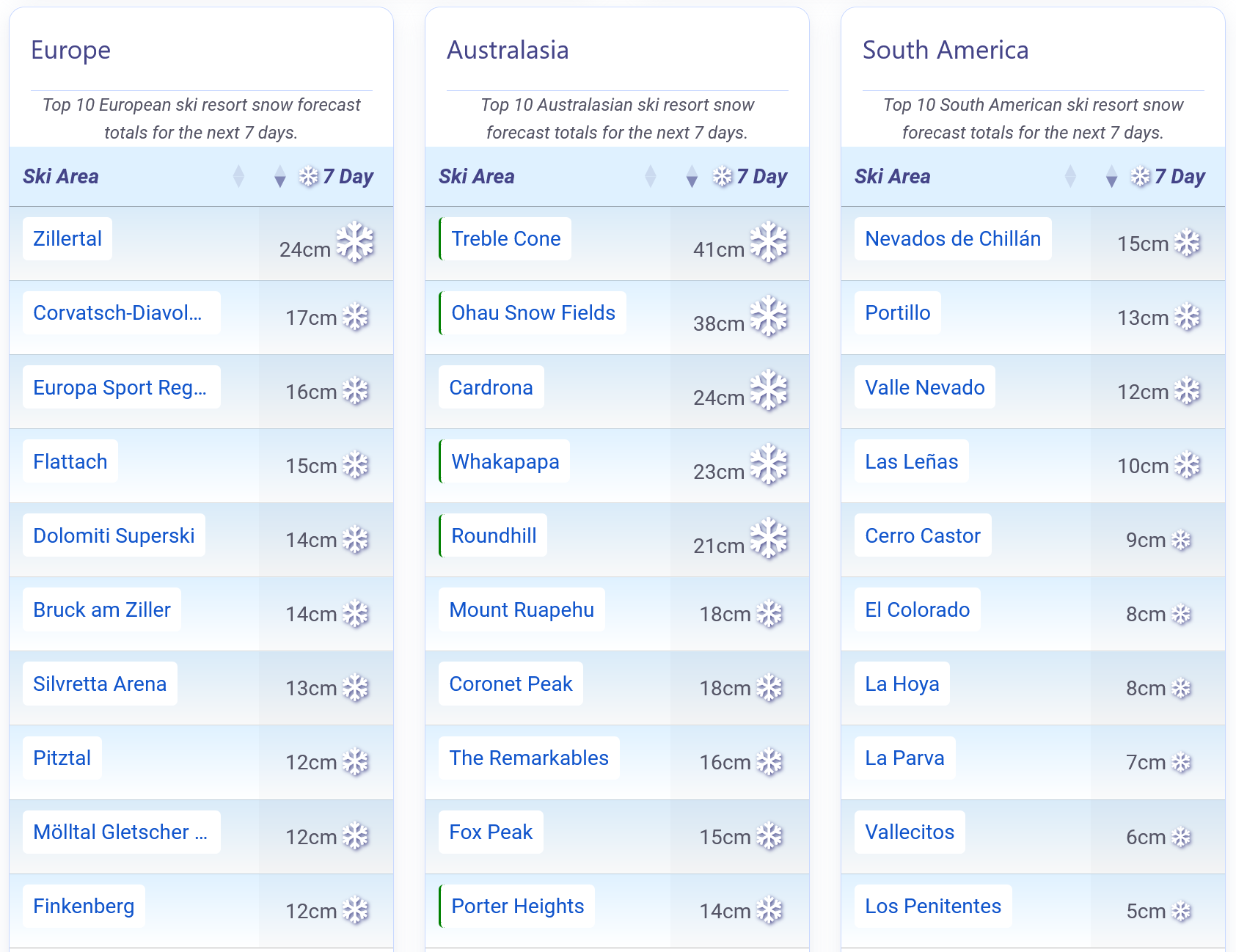
A little snow in the forecast for New Zealand, South America and high in the Alps.
Re-publication :- the J2Ski Snow Report Summary, being the text above this line, is free to re-publish, but must be clearly credited to www.J2ski.com with text including "J2Ski Snow Report" linked to this page - thank you.
World Overview
Australia definitely feels a month or two further into springtime than it should be. Its 2026 season has taken another hit, probably terminal, with heavy rain damaging thin bases and forcing early closures across Victoria.
Only Perisher and Thredbo in New South Wales remain open, with very limited terrain.
New Zealand continues to fare far better, with almost all centres still posting 90–100% of terrain open despite mixed weather.
South America continues to have the deepest snowpack by some distance although the past week has been mostly sunny.
In the northern hemisphere Italy's Passo Stelvio brought some welcome good news last Friday, reopening its summer glacier slopes with little warning after temperatures finally dropped enough to refreeze the glacier and end a three‑week shutdown that had closed all Alpine summer‑ski centres.
Across the Atlantic, although we're still nearly two months from the likely first resort openings for 26-27, spirits have been raised as North America has seen further high‑altitude snowfall turning peaks whites at resorts including Mt Bachelor and on Mt Hood.
Southern Hemisphere
Australia
Sadly Australia's troubled season has taken another hit, with warm, wet weather stripping the last of the already‑thin snowpack on most slopes.
Mt Hotham confirmed it would shut on Sunday, September 6, noting that despite sustained efforts, conditions left no viable options. Mt Buller followed suit, closing the same day, as did Falls Creek, meaning all centres in Victoria are now closed.
At present, only Perisher and Thredbo remain open in New South Wales, both offering very limited terrain. Thredbo is down to a short stretch on Friday Flat, while Perisher reports roughly 15% of runs still skiable.
Colder nights and possibly brief high‑altitude snow showers are forecast which may offer minor surface recovery, but overall conditions stay marginal.
Thredbo announced on Thursday that this coming Sunday will be its closing day, Perisher has been defiantly posting video of overnight snowmaking over recent days though!
New Zealand
New Zealand's ski fields have seen another highly changeable week, swinging between sunshine, rain, fresh snow and strong winds that caused occasional closures. Monday delivered the standout conditions, with clearer skies, lighter winds and up to a foot (30 cm) of new snow, producing excellent spring skiing.
Despite the variability, New Zealand continues to offer the highest proportion of open terrain worldwide, with most areas operating 90–100%. Cardrona remains fully open with 45 km (28.0 miles) of skiable terrain, the most in the country, while Mt Hutt still holds the country's deepest cover at nearly 2m (6.6 feet) up top.
A mostly cold, dry stretch is expected into the weekend with light‑to‑moderate snowfalls expected to return at the start of the new week.
Argentina
Argentina has enjoyed a far calmer week after nearly two months of frequent snow storms, with most ski areas returning to the dry, sunny weather that defined early season. Light snow showers reached some southern provinces however, but added a few inches (5cm [2.0 inches]), while temperatures ranged mostly from –5 °C (23.0 °F) to +5 °C (41.0 °F), keeping snowpacks stable despite a few warmer afternoons. Resorts are now reporting their best terrain access of the season, with 70–90% of runs open.
The country's largest centre near Bariloche, Catedral Alta Patagonia, is close to 80% open and offers around 38 km (23.6 miles) of slopes, placing it among the world's most skiable destinations this week. Las Leñas is similarly near fully open and is posting the world's current second deepest upper base depth of 3.3m (10.8 feet).
Chile
Chile's ski areas remain locked into a cold, stable winter pattern, with upper‑mountain temperatures frequently dropping to –13 °C (8.6 °F) and bases climbing to milder daytime highs of +5 °C (41.0 °F) to +10 °C (50.0 °F).
The central Andes around Valle Nevado, La Parva and El Colorado remain almost fully open with a combined 125 km (77.7 miles) of terrain, the most available anywhere worldwide at the moment by some distance.
Southern centres, including Nevados de Chillán and Corralco, stay below freezing at altitude and Corralco's published upper base depth is now nearing 5 metres (16.4 feet), again the deepest in the world by some distance.
The forecast is looking mostly dry and sunny through the weekend and into the start of next week with temperatures varying between around -10 °C (14.0 °F) and +10 °C (50.0 °F).
Northern Hemisphere
There was some relief when one of the temporarily closed summer ski areas, Italy's Passo Stelvio reopened last Friday with little advance notice. A welcome drop in temperatures finally allowed the glacier surface to refreeze, ending a three‑week mid‑August shutdown that had temporarily closed every summer‑ski centre across the Alps. Operations have resumed on a reduced schedule to protect the fragile snowpack with ski lifts closing at noon.
With little new snowfall, terrain remains limited, however there was up to 10cm (3.9 inches) of snow above around 3,000m (9,843 feet) on Wednesday/Thursday, raising spirits. The closure was triggered by prolonged heatwaves that pushed freezing levels far above the glaciers, leaving surfaces too soft for grooming. Stelvio still hopes to run through to 1 November, though conditions will dictate daily operations.
Switzerland's Saas‑Fee and Zermatt remain shut for now but Italy's Val Senales still aims to open for its 26-27 season next weekend.
In addition, four of Austria's glacier areas (Hintertux, Kaunertal, Pitztal and Sölden) are each targeting late‑September season starts.
Further north, Norway's Galdhøpiggen is preparing to reopen, and Finland's Levi and Ruka expect to begin their snow-farmed seasons early next month.
There remains nowhere open in North America but Canada and the US have seen more high‑altitude dustings, including at Mt Bachelor and Mt Hood in Oregon.