

Messages posted by : J2SkiNews

(Library pic) Britain's most successful ever skier in World Cup competition, Sheffield's James 'Woodsy' Woods, has won the first Slopestyle Skiing World cup staged in New Zealand this morning. The 23 year old, who had been top qualifier, scored 90.2 points on the first of his three runs, and remained the only man to score more the 90 during the entire competition , taking the pressure off a little for the other two runs, Woods said. "Even three runs, if you bin the first run you're like 'my goodness, I've only got two runs' Whereas it definitely gives you that buffer and the pressure is always different. You know there's a big dog coming behind you," Norway's Oystein Braaten and American Joss Christensen took the other two podium places. Woods had already won one slopestytle contest since arriving in NZ but this was the first FIS ranked World Cup title of the 2015/16 season. Woods told media his victory hadn't "quite sunk in yet" He is also expected to compete in the Big Air final on Sunday. |
|

A dusting of fresh snow on glaciers in the Alps has raised excitement levels ahead of winter 2015-16 and following a long hot summer. Most summer glacier areas have now ended their 2015 opening – only Les 2C Alpes in France (Closing this weekend) and Cervinia in Italy (Closing the first weekend in September) are still open, although five other Alpine glaciers which are open year round or nearly year round are operating through the Autumn – Saas Fee and Zermat in Switzerland, Molltal and Hintertux in Austria and Passo Stelvio in Italy. Two glacier areas in Norway are also open. The Molltal glacier is currently hosting the Austrian Alpine squad. The dusting of snow – reported at the Zugspitze above Garmisch and Hintertux in Austria (pictured) comes in contrast to the ongoing thaw of recent months with daytime temperatures well above freezing for prolonged periods on most Alpine glaciers. Around a dozen glacier in Austria, France, Italy and Switzerland are scheduled to open to start the 2015-16 season from mid-September to mid-October, the first of these most likely Austria's highest area, Pitztal, which aims to open in just over three weeks on Friday September 18th, However all centres are making careful warning that their planned autumn opening is, "subject to snow conditions." |
|

Adult admission tickets to the London Ski Show have more than doubled in price for all 2015 event, with entry charged at £25 – more than double last year's £12 cost. The Telegraph which organises the Ski and board Shows in London and Manchester each autumn has not given a reason for the big price increase – which applies to the London show only – but is talking about this year's show being more of an entertainment event, with stars from the Altitude Comedy Festival in Mayrhofen performing and a promised Alpine themed village. After many years being staged at London's Olympia or Earl's Court, this year's event will also move to a new venue near Battersea, be cut again from five down to four days, and take place slightly later in the year from Thursday to Sunday over the first weekend in November. The London show often offers a lot of free or 2-4-1 admission tickets via partnerships with ski businesses, most noticeably last year The Snow Centre indoor snow centre and their in-house ski magazine. They are also currently selling 'early bird' tickets online at 20% off the new price, down to £20. This autumn Londoners have a second major snow themed attraction happening the weekend after the show, when London's Freeze festival returns, this time with FIS World cup accreditation to stage a big air event. Freeze will be staged in the Queen Elisabeth Olympic Park and has attracted the support of the London Mayor's office and the National Lottery. Music acts are promised along with spectacular world class competition. Early Bird tickets for it are priced at £40. |
|

(A lift, but not THE lift, in Val d'Isere) There's been talk of redeveloping Val d'Isere's famous Solaise sector at the heart of its ski area for decades, but the project is now finally underway. It will partially be completed this coming winter, but it a two year project so will not be fully finished until winter 2016-17. Solaise is one of the two iconic mountains reached from the resort's front de neige base area and Val d'Isere's lift company is spending €16m (£11.1m) on a complete make over which includes a massive earth moving project as well as a new lift. Bulldozers have already moved about a million tons of earth to create the base for an all new mid-mountain station at 2500m which is one of the parts scheduled to open this coming winter. The old Solaise Express quad chair-lift and the cable-car will still be in operation this winter but will be replaced by a high speed, hi-tec 10-person gondola with 91 cabins, complete with heated seats and wifi from November next year. You can park your skis in exterior baskets or bring them inside - the choice speeds up loading time. The new gondola will increase capacity by 40% and can carry up to 3,600 passengers per hour, bringing an end to any previous peak hour bottlenecks at the base on high season dates. Journey time will be just seven minutes. On the Val side of Solaise a giant, covered magic carpet lift has replaced the old Terrasse button lift. This serves a new secluded beginner area for both adults and children without the distraction of other skiers whizzing by. The slope has been regraded from around 16% to 7% to make it a secure learning area. The lift also serves a new tubing area for kids and adults. On the far side of Solaise twin, covered magic carpets have replaced the short double chair that brought you to the summit. Top stations for all three lifts are on one level beside the new day lodge containing a café, a picnic area, a sun terrace and toilets. It's a place where you can relax and enjoy spectacular views from the floor-to-ceiling windows. The lift company has taken every step to minimise the environmental impact of the project. The redevelopment reduces the number of lift stations from a total of eight with 34 pylons to just two with 16 pylons. The gondola machinery is being buried underground at the base area. This significantly reduces the noise impact both for inhabitants and the fauna living around the front de neige. |
|
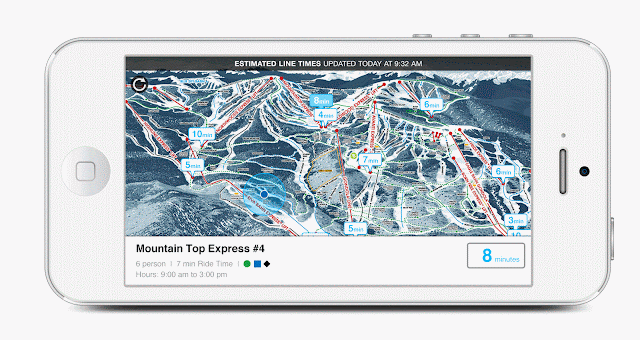
Two news stories from Colorado's 'big two' resort groups in the past few days have pointed to the latest stages of how the rapidly evolving use of technology on the ski slopes may be used and controlled in the wider world. Firstly Vail Resorts have announced that they will 'crowd source anonymised data' from the mobile phones of people on the slopes of their four Colorado resorts this winter in order to gather data on where lift queues are building up. Secondly Aspen have announced they're banning the use of drones at their four Colorado ski areas. The increasingly popular, easy to obtain and affordable devices are becoming an ever more common site on ski slopes, with Aspen says, potential dangers particularly for ski lifts and in the case of its Buttermilk ski area, nearby planes using the local airport. The US Forest Service, which controls much of the land on which many US ski areas operate, had already clarified its position on private drone usage earlier in the year saying any operators must have official permissions from the country's Federal Aviation Authority. The Vail Resorts move is the highlight of the fifth edition of the group's Epic Mix app, which has been called 'Epic Mix Time.' The new feature, based on similar recently introduced technology used at New York's JFK airport and Disneyland parks, collects anonymous location and movement data from phone and similar device users on the slopes to cleverly calculate queue times at most lifts at the resorts of Breckenridge, Beaver Creek, Keystone and Vail. It then transmits collected queue data back to Epic Mix App users top they can see where there are queue free lifts, helping skier flow around each ski area. Slope users do not need to opt in and cannot opt out (except by not carrying a phone that is turned on presumably) for their phone's data to be used in the process, however the technology appears to avoid privacy laws as firstly it does not collect personal data and secondly the collected data is almost immediately permanently 'dumped' after it has been used for the live queuing calculations. The Epic Mix Time technology will be rolled out at Vail's other ski areas in California, Utah, the US Midwest and Australia in winter 2016-17. |
|

The 4 Valleys, Switzerland's largest ski area, has announced it will cut prices in some quieter mid-season weeks in a bid to attract more business. The region which links half a dozen ski villages, the largest and best known of which is Verbier, is also considering introducing more 'dynamic pricing' for its lift passes – essentially pricing according to demand as has been the model in the hotel and airline industries for several decades now. Resort managers told local media that the move is a response to falling lift pass sales and the strong Swiss Franc. Price cuts so far announced are not particularly spectacular, although they'll no doubt be welcomed by skiers. Reductions announced so far are around 10% on day pass prices during the low season weeks following the peak New Year week. That period had been enjoying increased business from the Russian market. Celebrating their Orthodox holidays several weeks after the western Europeans, but with the dramatic decline in rich Russian visitors following the Ukraine crisis, it feels more like low season again. It is not in fact unusual for ski areas to offer discounts in January in many ski nations to encourage demand, but in Switzerland prices are generally fixed all winter regardless of how busy a resort is and how much terrain is open. Many Swiss resorts have held their prices for several seasons leading to a reduction in real terms for Swiss guests, although with the Franc performing better than most other currencies, prices have still appeared to rise for most non-Swiss nationals. The 4 Valleys will also offer a 5% discount to tickets bought online in advance. |
|

Forecasts by some snow forecasting services that the Andes were set to receive up to 2m of fresh snow this week do not seem to be as wide of the mark as some commenting sarcastically on social media first thought. Snowfall in the last few days in Chile has passed the metre mark at several resorts already, with Portillo, which has had 125cm of fresh snow this week, receiving more than 65cm (over two feet) of new snow in the last 24 hours alone. So there are powder conditions for those in resort now but all access roads are blocked meaning that no one can leave or enter the famous resort. "Central Chile is being pounded by one of the biggest storms to hit in years. Valle Nevado, as of Wednesday afternoon, has received three feet (90cm) of new snow, and expects several feet more by Sunday," said a statement from another leading ski area in Chile. The huge snowfall is the second of its scale in a month after the continent's ski areas had to delay opening by up to four weeks from mid-June to mid-July due to no snow and warm weather at that point. As usual Google's snow reports were completely inaccurate and failed to record the latest accumulations, claiming Portillo, for example, has had 1cm per day rather than the 60cm+ per day it actually has. Western North American ski areas have begun to mention the big snowfalls south of the equator claiming that it reflects a long awaited shifted in the el Nino/La Nina Paciic weather cycle in favour of big snowfalls which they hope will continue to winter 15-16, bringing an end to a four winter drought of snowfall. |
|

The IOC has just announced that Beijing will be the host city of the 2022 Winter Olympics at its annual meeting, in Kuala Lumpur where the host for the results ceremony was Britain's famous triple jumper Jonathan Edwards. The results came after a paper ballot was needed when the electronic one failed. It will be the first time a city has hosted summer and winter Games. It will be the third Olympic Games in a row in Asia, following the decision to stage the 2020 summer games in Tokyo, and the third Winter Olympics in a row to move successively East wards after Sochi in 2014 and South Korea in 2018. IOC delegates had only two candidates to choose from after four European nations pulled out, in several cases of local referenda, normally siting costs being too high to stage the Games, although when Oslo, which was a third remaining finalist pulled out, Norwegian media also reported on what it considered excessive demands by the IOC. In response IOC officials said the benefits of staging an Olympics greatly exceeded the costs. As with the last and next winter Olympics, there was going to be controversy too, whichever candidate the IOC had chosen. Kazakhstan has almost no winter sports history and has developed its few new resorts from scratch with oil money rather than organically due to public interest. It has high mountains but low natural snowfall. Beijing's Alpine events would be staged 100 miles away in a fast developing ski region but like South Korea the mountains are not high making it difficult to find a venue with the vertical to host a Men's downhill (as has been the case for the 2018 Games in South Korea, requiring the creation of a course in an environmentally sensitive area of natural parkland)( and like Kazakhstan it has little natural snowfall, meaning either venue would mean boom times for snowmaking manufacturers. Unlike Sochi however, dubbed 'The tropical Winter Olympics' both areas are at least normally very cold. The IOC also decided that the 2020 Youth Olympic Winter Games would be staged in Lausanne in Switzerland, beating in Brasov in Romania. |
|