

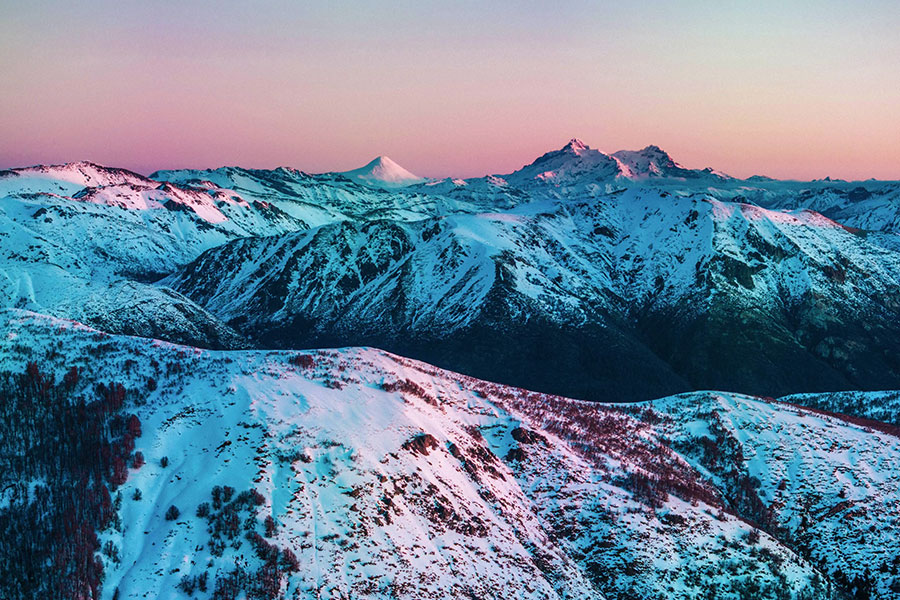
Spring sunset at Nevados de Chillán, Chile...
Fresh global snowfall is improving glacier ski conditions in the Northern Hemisphere as the Southern Hemisphere experiences a varied end to its winter season.
The Snow Headlines - September 17th
- Up to 20 cm/8 inches of fresh snowfall, high in the Alps.
- Perisher only ski area still open in Australia after Thredbo ends season early.
- Norway's Galdhøpiggen summer ski centre expected to reopen this weekend.
- Fresh snowfall reported in Alberta Rockies for third time in past month.
- Second Italian glacier planning to open for 26-27 this weekend.
- 15 cm/6 inches snowfall in US Pacific Northwest.
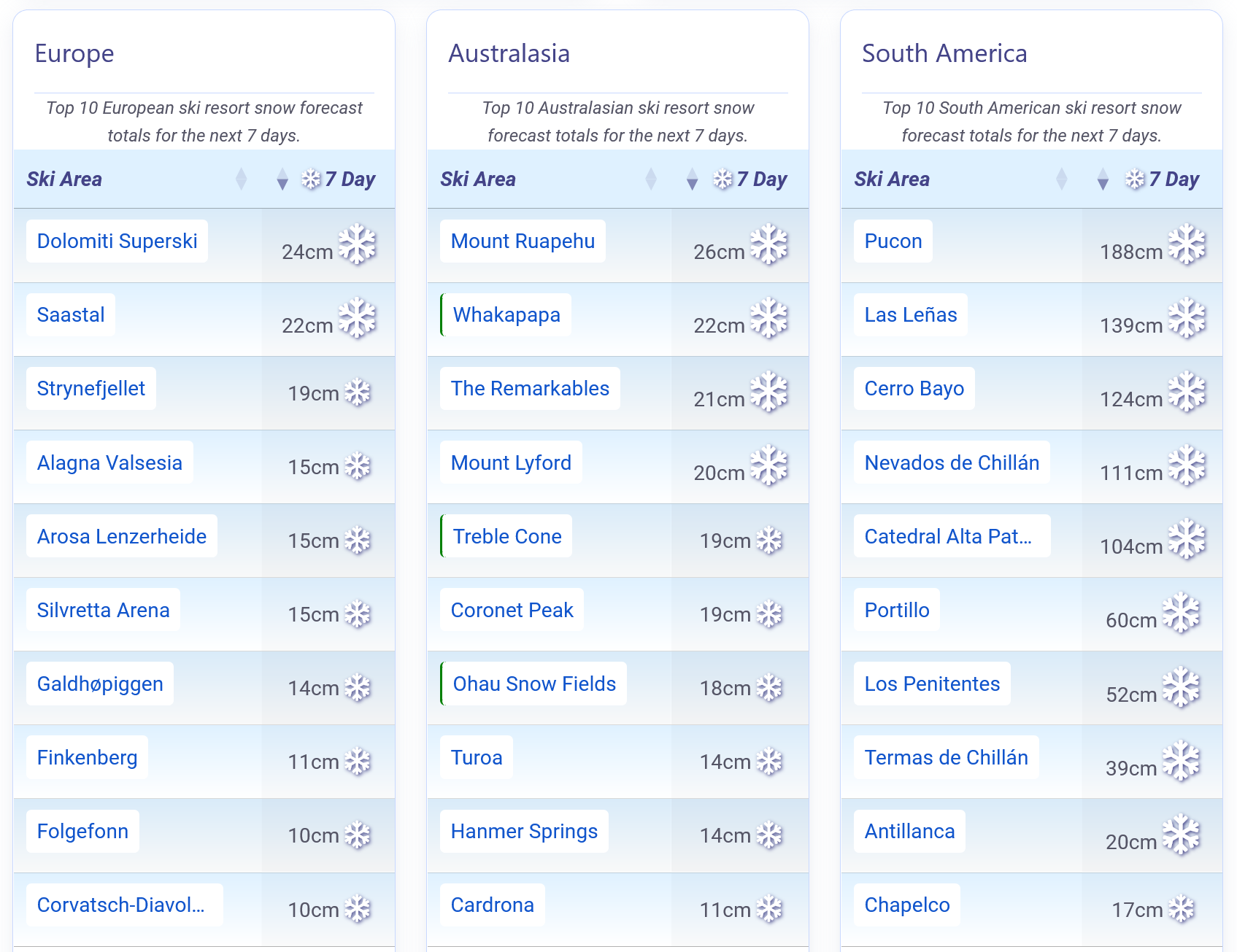
Heavy snow forecast for South America.
Re-publication :- the J2Ski Snow Report Summary, being the text above this line, is free to re-publish, but must be clearly credited to www.J2ski.com with text including "J2Ski Snow Report" linked to this page - thank you.
World Overview
Snowfall has been reported in Canada, the Alps, the Andes and New Zealand, aligning with the seasonal shift between hemispheres. Alpine glaciers saw up to 20 cm/8 inches above 3,000 m/9,843 ft, a welcome change after prolonged summer warmth.
Several glacier areas preparing to open later this month noted improved conditions following fresh snow and colder nights. Around six Alpine glaciers still plan to open before the end of the month if conditions allow. In Norway, the Galdhøpiggen summer ski area expects to re-open this weekend after weeks of sub-zero nights, light snowfalls and near-freezing daytime temperatures.
Conditions vary across the Southern Hemisphere, as they have done all season. Australia is nearing the end of its challenging season, with only one area still operating a small part of its terrain and reliant on snowmaking. New Zealand remains cold, with good snow depths and most terrain open.
Argentina is warming into spring, but strong winter bases keep most slopes available. Chile has enjoyed sunshine with some southern snowfall, and most centres remain fully or nearly fully open with notably deep snowpacks thanks to the big July and August snowfalls.
Southern Hemisphere
Australia
Thredbo closed last weekend, leaving Perisher as the final Australian resort still operating after a very challenging season that has now seen all but one resort close early. Perisher, which is posting a base of less than 15 cm/6 inches, has been pushing a positive message over the past week, sharing images and video of overnight snowmaking, freshly groomed white strips of snow and busy, upbeat scenes on its limited terrain (about 15% of its runs still skiable).
The past week has been mostly sunny, but colder nights and slightly cooler daytime temperatures have helped Perisher maintain operations, with conditions just supportive enough for continued snowmaking and grooming. It reported a 4 cm/2 inch snowfall on Tuesday but also announced it will be ending its season 10 days earlier than hoped, now next Friday 25th September.
New Zealand
New Zealand's ski fields have seen the familiar mix of conditions over the past week, with slightly more settled, dry weather than earlier in the season and only occasional light snow showers. Temperatures have stayed comparatively cold for the southern hemisphere, with higher terrain dipping towards –10 °C overnight and daytime highs hovering close to freezing.
As a result, most South Island commercial ski areas remain fully open, supported by healthy mid-season snow depths. Mount Hutt continues to report the country's deepest top-to-bottom cover with over a metre at its base, nearly double that at the top, while fully open Cardrona retains the largest skiable terrain at 45 km/28 miles. Both plan to stay open at least another month.
Smaller centres and club fields present a more mixed picture, with some reporting insufficient snow to continue and others choosing to wrap up their 2026 seasons regardless. Mount Lyford was among those announcing closing for 2026 last Sunday.
Argentina
Spring is setting in across Argentina, bringing a stretch of mostly sunny days, milder afternoons and overnight lows hovering around freezing. Despite the warmer trend, the heavy snowfalls of July and August have left the country's ski areas with exceptionally strong bases, and most continue to offer 70–90% of terrain open.
Catedral remains the country's largest and most extensively open resort, still providing more than 40 km/25 miles of groomed, lift-served skiing and maintaining a solid upper-mountain snowpack. Conditions are robust enough that Catedral has confirmed operations through 4 October.
Las Leñas continues to post Argentina's deepest snow, with 1.30 m/4 ft at base, 2 m/7 ft mid-mountain and up to 3.30 m/11 ft at the summit. Its season is scheduled to run until 28 September, so is into the final fortnight, unless an extension is announced. Elsewhere, Chapelco, Caviahue, Cerro Bayo and La Hoya are all operating into late September, with several planning to continue into early October if conditions hold. Caviahue, for example, is carrying around 1 m/3 ft at base and up to 2.5 m/8 ft up high, giving it one of the strongest late-season reserves in the region.
Chile
Spring has also taken an increasing hold across Chile, delivering a predominantly sunny week, although southern resorts such as Nevados de Chillán did see fresh snowfall heading into last weekend. Overnight temperatures on higher terrain continue to dip to around –5 °C, with base-area afternoons climbing to +11 °C, giving a classic early-spring mix of firm mornings and softer afternoon snow.
Despite the warmer pattern, Chile's ski areas remain in excellent shape. Most major resorts are still fully open or close to it, thanks to the exceptional winter snowpack.
The country also holds the deepest reported snowpack in the world, with Corralco carrying close to 5 m/16 ft of upper-mountain snow. Lift-linked Valle Nevado, El Colorado and La Parva near capital Santiago continue to offer the most lift-served terrain available anywhere, with about 125 km/78 miles of slopes between them and near-complete operations.
Forecasts also indicate additional snowfall pulses later this week, with Portillo, Valle Nevado, La Parva, El Colorado, Nevados de Chillán and Corralco all expected to receive 15–40 cm/6–16 inches of new snow - possibly more - by the weekend.
Northern Hemisphere
Europe
September has delivered the first meaningful signs of winter across the Alps, with fresh snowfall reported at high elevations in Austria, Switzerland and Italy. Up to 20 cm/8 inches fell above 3,000 m/9,843 ft, a welcome reset after months of record heat that stripped most glacier cover.
Sölden and Pitztal, both aiming to begin their 2026/27 glacier season in just over two weeks, reported new snow, while Passo Stelvio, the only summer ski area to have reopened so far after all were forced to close during August's extreme warmth, was once again snow-covered. A second Italian glacier, Val Senales, says it is opening as planned this coming weekend for its 26-27 season, although initially its limited terrain will be used mostly for race training.
Further north, Norway's Galdhøpiggen summer ski centre will reopen on Saturday, supported by overnight lows between –1 °C and –6 °C and occasional light snowfalls. Ruka and Levi ski areas in Finland have also been removing covers from their huge piles of snow-farmed snow, ready to start spreading it back on the slopes, with both planning to open for 26-27 in just a fortnight.
North America
Canada has also seen early-season snowfall, with flurries reported in Alberta and British Columbia at the same time as the Alpine snow.
In the US, high terrain along the Wyoming–Montana border saw fresh snow at the weekend, marking the seasonal shift. Crystal Mountain in Washington state then posted the biggest falls, about 15 cm/6 inches up high. The Rockies have also seen a dusting on higher slopes over the past few days.
Colorado's Loveland plans to begin snowmaking later this month, while Copper Mountain continues to offer hike-to terrain park access.
Early signs point to a typical mid-October start for the first North American openings, although the 'Super El Niño' forecast to peak just as the season is due to start, potentially bringing huge snowfalls for some, is an interesting extra factor this winter.