

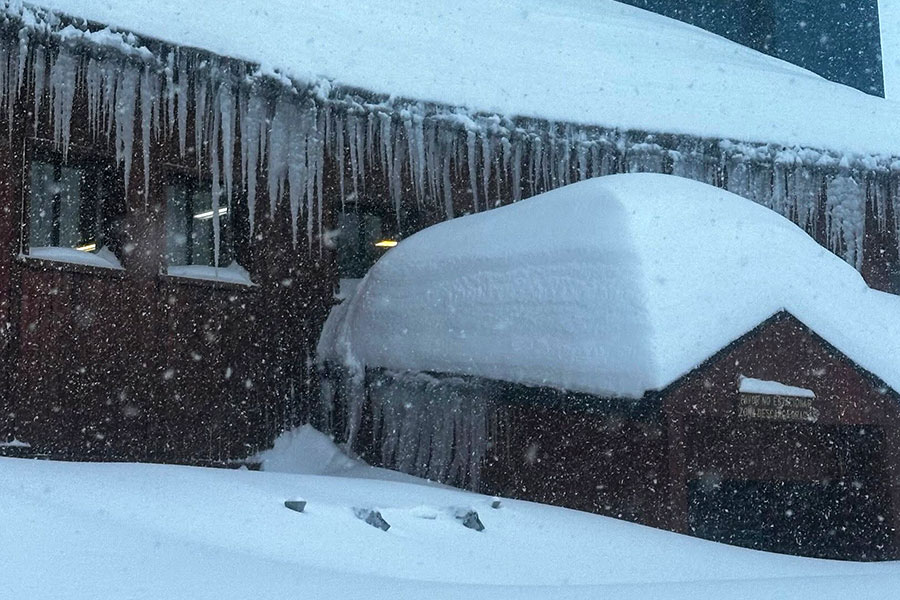
Portillo, Chile, buried in new snow...
A huge snowstorm has transformed the season in the Andes, with Chile's Portillo receiving nearly 4.7 metres/15 feet of snow in a week, while Australia and New Zealand report varying snow conditions.
The Snow Headlines - July 23rd
- Massive snowstorm hit the Andes, transforming previously poor season in Argentina/Chile.
- Chile's Portillo reports 4.7 m/15 feet of snowfall in a week.
- Aussie ski areas still battling warm, dry weather but now report up to 30% of slopes open.
- Saas-Fee opens for summer skiing which morphs into 26–27 ski season.
- Austria's formerly year-round Hintertux glacier ski area closes slopes for summer.
- Last lift-served ski area open in North America ends 25–26 season.
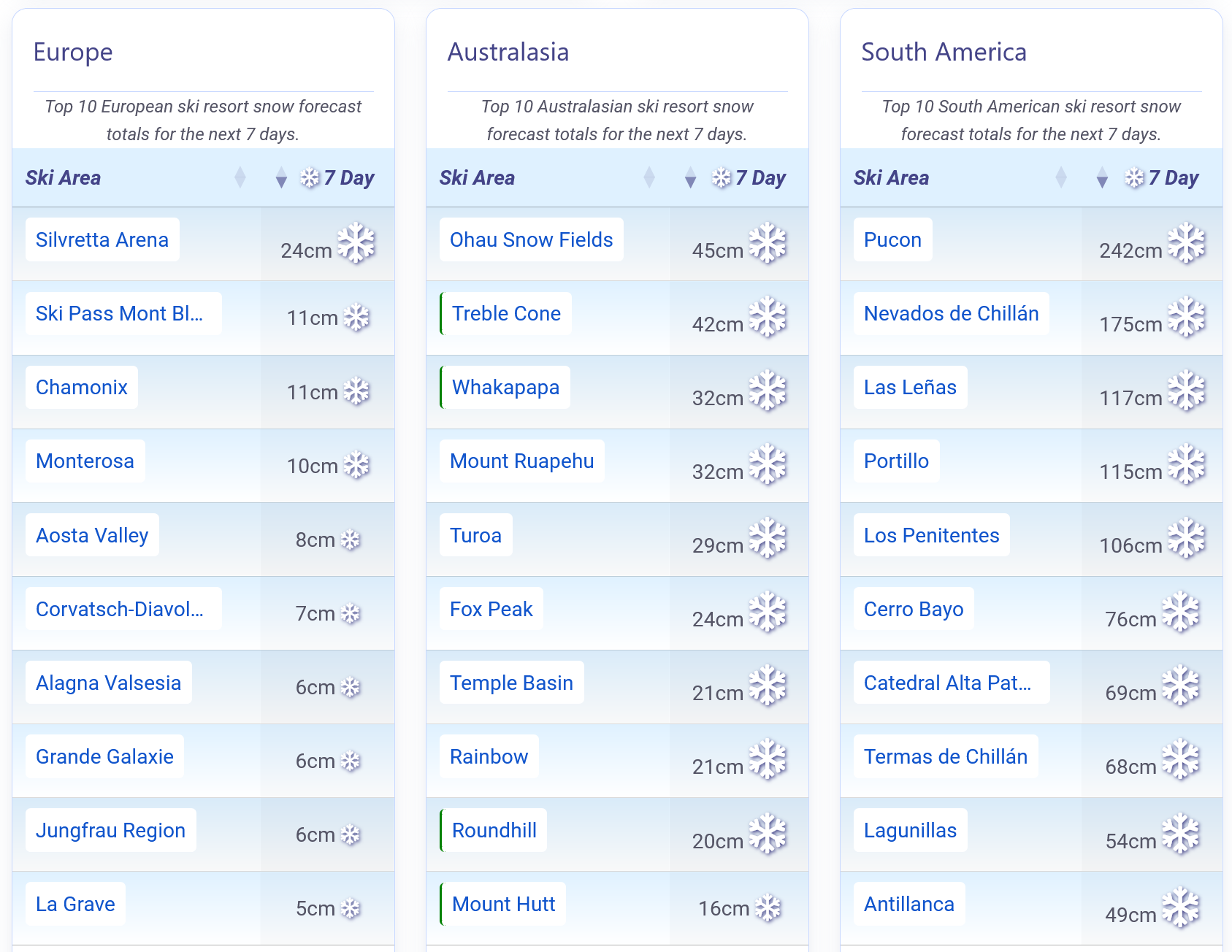
The snow is forecast to keep coming for South America.
Re-publication :- the J2Ski Snow Report Summary, being the text above this line, is free to re-publish, but must be clearly credited to www.J2ski.com with text including "J2Ski Snow Report" linked to this page - thank you.
World Overview
The main news this week is a huge snowfall on South American mountains bringing accumulations exceeding 3 metres/10 feet to some resorts, with snowfall rates peaking at up to 2.7 m/9 feet in 48 hours at the weekend. Ski areas in Argentina and (particularly) Chile are still digging out, but a big transformation in the previously lacklustre season should allow them to open most terrain when safe to do so.
Elsewhere in the southern hemisphere, it has been quieter in New Zealand after big snowfalls earlier this month, with most commercial areas now 60–100% open. Aussie areas continue to struggle with thin cover and limited terrain open after a mostly dry, mild week.
Summer skiing operations have changed across the northern hemisphere this week, with all lift-served outdoor ski areas in North America now closed until autumn/fall whilst the Alps and Scandinavia maintain a handful of high-glacier summer ski operations. Saas-Fee opened for its 26–27 season at the weekend. However, Hintertux, the last area open in Austria and formerly open year-round, has closed its operations until September. Warm temperatures and high freezing levels continue to limit terrain, with overnight refreezing and occasional light snowfall helping preserve upper-elevation slopes.
Southern Hemisphere
Australia
After the much-needed snowfall last week, dry, sunny weather has returned to Australia's ski fields, with daytime highs near +10 °C not favourable for the thin cover. Overnight lows have been just cold enough for limited snowmaking, allowing resorts to report their best, though still modest, volumes of terrain open so far this season.
Thredbo, with 25–45 cm/10–18 inches of cover, leads the country in terms of currently skiable runs at roughly 15 km/9 miles open, about a third of its full terrain. Falls Creek and Perisher have the second most, reporting roughly 10 km/6 miles of slopes skiable each.
New Zealand
New Zealand's season now looks far more typical following early-July snowfalls, with most ski areas shifting from minimal openings to 60–100% of terrain available. This past week has been quieter, bringing occasional snow showers but no major new accumulations. Clear spells and temperatures between –5 °C and +5 °C have supported regular overnight snowmaking and limited daytime thawing.
Mount Hutt, at 78/133 cm/31/52 inches, no longer holds the world's deepest cover after the huge Andes storm, but still leads nationally with most terrain open. Coronet Peak, on a thinner 30/40 cm/12/16 inches base, reports roughly 30 km/19 miles skiable.
Argentina
Most Argentine ski areas stayed cold this past week, picking up regular light to moderate snowfall, with the heavier dumps seen in Chile largely missing them.
Most resorts reported 10–20 cm/4–8 inches of new snow, with bigger 48-hour totals up to 70 cm/28 inches at Las Leñas and southerly Cerro Castor. Open terrain remains limited so far, with many centres still below 35% of available slopes.
Conditions are gradually improving thanks to steady top-ups, and a strengthening wintry pattern is expected across northern Patagonia, with the continent's largest resort Cerro Catedral by Bariloche likely to see frequent snowfall and –8 to –1 °C on upper slopes.
Chile
Chile finally ended its long mostly-dry spell with a week of exceptional snowfall, delivering far more snow than most areas could immediately manage.
Portillo, which had seen only 60 cm/24 inches in two months, received more than five times that in three days, reaching 4.2 m/14 feet of snowfall by Wednesday and nearly 4.7 m/15 feet by Thursday with the snow still falling and much more forecast. It posted 24-hour totals of up to one-and-a-half metres/5 feet along the way. The resort has remained closed for safety, whilst others opened limited terrain amid access issues.
Valle Nevado (90/170 cm/35/67 inches) reports 260 cm/102 inches since Friday, operating about a third of its terrain.
A cold, unsettled pattern persists across the central Andes, with continued snowfall expected for many areas. Upper-mountain temperatures fall to –6 to –3 °C, bases –2 to +2 °C. Southern areas, including Nevados de Chillán and Corralco, see mixed precipitation but fresh snow on higher slopes. Winds should stay light, with clearer spells developing into the weekend.
Southern Africa
Lesotho's Afriski remains open with 15 cm/6 inches of snow on the upper slopes, all of it machine-made. Overnight temperatures around –6 °C have kept surfaces firm early, though daytime highs near +10 °C soften cover by afternoon. No new snowfall has been recorded since early June, but 89% of terrain is open. Looking ahead, the freezing level fluctuates between 3,300–4,400 m/10,827–14,436 feet this week, keeping conditions mostly dry and sunny with just occasional cloud.
Northern Hemisphere
Last weekend saw the last lift-served ski areas still open for the 25–26 season finally close in North America.
Meanwhile, Saas-Fee became the first northern hemisphere ski area to open for the 26-27 season (stretching the definition a bit, but that's the plan), where the Allalin 2 and 3 T bar lifts started spinning on the glacier on Saturday, despite temperatures in the Alps reaching 20 °C at 1,800 m/5,906 feet.
Two other glacier ski areas remain open in the Alps: Switzerland's Zermatt (also accessible from Cervinia) and Passo Stelvio in Italy. The freezing point has dropped slightly to around 3,000 m/9,843 feet overnight and a few centimetres/1–2 inches of snowfall have been reported through a mostly dry week, with further daytime thawing as the freezing point moves back up to 4,000 m/13,123 feet.
The 25–26 season also ended on Sunday at the last centre that had been open in Austria, Hintertux. Along with Zermatt, it had been one of the last ski areas open year-round, but in recent summers had struggled to keep slopes open through high summer. This year it announced in advance it would close its slopes from July to September without naming which day it would do so. That final day of its 25–26 season appears to have been last Sunday, 19th.
Norway's Galdhopiggen Glacier also remains open with all slopes skiable and even some fresh snow showers reported, with overnight lows of –5 °C, although daytime highs have been creeping up to +10 °C.
With Timberline closing earlier than usual, only the hike-to terrain park at Copper Mountain in Colorado is open for outdoor freestyle skiing, although you can also ski indoors at Big Snow in New Jersey.