

Messages posted by : J2SkiNews

(Mt Baker in a snowier year...) The ski resort that holds the world record for receiving the most snow in one season is currently closed due to lack of snow cover, and may post its worst ever season. Mt Baker in Washington state, Western USA, regular receives 750 inches (62 feet/19 metres) of snow each season on average and in the winter of 1998-1999 set a world record when it received 95 feet (29 metres) of snow through the season. This winter is looking to be another record breaker for the wrong reasons though, with Mt Baker unable to open until December 20th and currently unable to operate due to inadequate snow cover. The resort has a third of its normal snowpack for this time in the season. "This year we've shovelled snow, hauled snow, mined snow, pushed snow, and groomed snow all over the mountain to the best of our ability in order to keep things in good shape in skiable conditions," said a resort statement, "But we're going to suspend operations temporarily until we get some more snow. Maybe we need about 6-12 inches more, and we'll be right back in operations." Sadly the new snow doesn't look likely any time soon as temperatures have been up in double figure Celcius in recent days. The warm weather and lack of snow, caused by a Pacific weather pattern, has impacted the entire West coast of North America all season and at times stretched in land as far as Colorado, Utah and Alberta where rain has occasionally fallen in areas where temperatures and normally at double digits below freezing and powder snow is the norm. Many smaller ski areas have been closed along the coast, including Cypress Mountain near Vancouver in BC, the 2010 Olympic venue, while larger areas have had less terrain than normal open. There was some respite ion the last week on February and first week of March in some areas with heavy snow in parts of California and Colorado. |
|
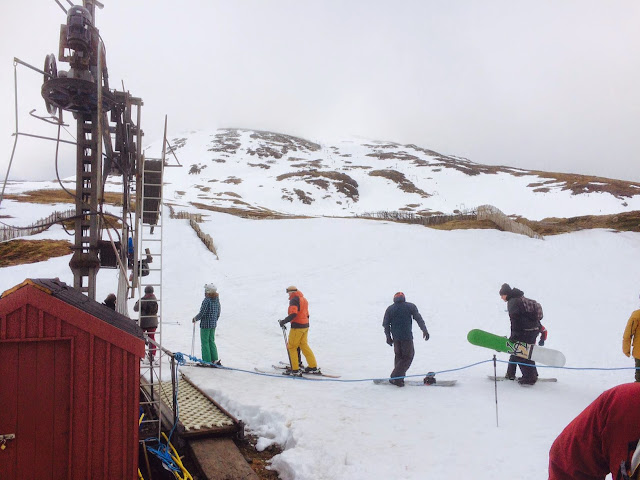
The five ski areas in the Scottish Highlands have seen a weather roller coaster over the last four days with temperatures climbing towards double figures, leading to a serious thaw at the weekend, followed by up to 115mph+ gales battering the mountain sides over the last 36 hours. Most of the areas had to close at one point or another due to the winds or, in Glenshee's case, the thaw. The good news is that after the gales last night, temperatures are back below freezing on the hills, and some fresh snow came in between the windy blasts. It's now a perfect day with blue skies and brisk breeze. The bad news is that more storms are expected in the next few days. On the west Nevis Range reports it's a good day there and they're getting ready to go, but that it will take a little longer than normal as lifts had to be tied down because of the gales. Glencoe (Pictured above yesterday) reported they had survived the thaw and expect to open later today but presently the gales have knocked out their electric supply, so they're waiting for that to be fixed. In the Central and eastern Highlands Cairngorm, which could not run its funicular train yesterday because of the strength of the winds, reports excellent conditions and The Lecht is also operating with limited terrain due to the thaw taking some cover away. Glenshee had been closed due to the thaw but today reports fresh snow has allowed them to patch up some runs and they have limited terrain open. Despite the perennial problems of battling extreme weather in order to operate, Scottish ski areas are currently reporting one of their best seasons this century in terms of consistent snow cover at all five Highland centres and resulting healthy skier numbers. |
|
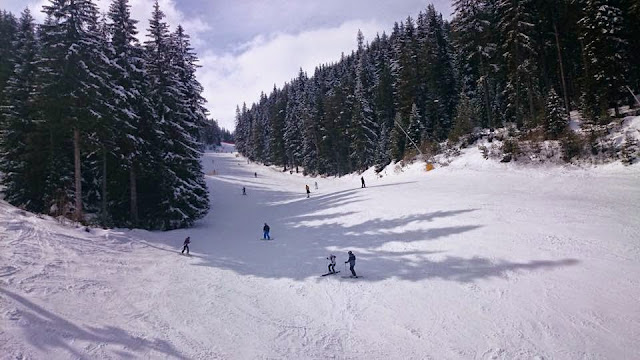
(Bansko last week before the snow storm hit) A snow storm currently dumping on Bulgaria is reported to be possibly the heaviest for 30 years, according to comments from locals reproduced in the Sofia Globe newspaper. The country's ski regions (and much of the rest of the nation) are currently on yellow and amber severe weather warnings for snow and the storms, which really picked up over the weekend, have blocked roads and brought down power lines across the country, with the south particularly badly affected. The country's ski areas, which were already reporting a fairly good season since the start of the year with regular snowfalls and a good base depth built up, have reported 2-3 feet (60-90cm) of snow in the last 48 hours, much of it in the 24 hour period from Saturday to Sunday, when Borovets reported 60cm/2 feet in that period alone. Ski areas have attempted to continue operating despite the logistical problems the snow has caused. In Bansko the gondola was forced to close for an hour on Saturday whilst snow was cleared but is now operating again, Pamporovo closed its whole ski area for a while. In a separate incident outside Banskos ski area boundaries three snowboarders freeriding off piste were killed in an avalanche on Saturday. The snow is expected to continue with less intensity until at least Wednesday. |
|
|
Oh thanks for correction on number of seats, have updated...
|
|
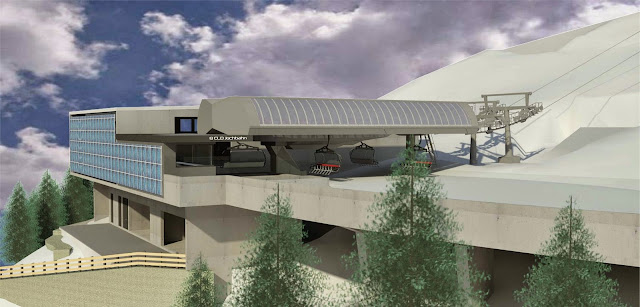
Austria's Brixen im Thale, part of the giant Skiwelt area, has announced it will be installing what it claims will be the world's fastest chairlift in time to begin operation next winter 2015-16. The new Jochbahn, a detachable eight-seater chairlift, will operate on the resort's Sonnseite ("Sunny Side") and be nearly two and a half times faster than the lift it replaces, travelling at a world beating six-metres per second (mps) compared with the 2.5mps of the older lift. The Jochbahn, which comes with a €12m price tag and an impressive hourly uplift capacity of 3,000 people, deploys not just the very latest technology, but the route will be extended too. The new valley station is situated at the same level as Gasthof Nieding, so the lift is now more than double its previous length, but thanks to its high speed, the journey time is considerably less compared to the old lift. The old Holzalm drag lift has had to be dismantled to make space for the new construction and the new piste. The new lift track was built without any earth movements and land clearances and the existing slopes were harmoniously integrated into the Jochbahn's new downhill run. Skiers above – cars below. Thanks to a spectacular underpass near Gasthof Nieding, the piste now crosses over the access road so no junction is needed and that's a great safety feature for the popular Brixen valley descent. The lift itself is a veritable gem and forms one of the most modern systems in the entire SkiWelt. All 75 chairs on the two-kilometer Jochbahn will be equipped with comfort suspension, heated seats and weather protection hoods. The new lift is not only the fastest of its kind anywhere in the world, but it is also a system that in terms of comfort performs in the top league. There's a solar panel farm covering 180 sq.m (on the south side of the chair garage) and this has an important role in ensuring that the energy supply for new lift is sustainable. "With the construction of the extended Joch lift and the new Joch descent, which has already opened this winter, Brixen now has a very attractive, varied, sunny and snow-assured (constantly machine snowed) piste paradise, which appeals not just to families and beginners, but also to dedicated skiers," said a SkiWelt statement. With 90 cable cars and lifts, 280 kilometres of ski slopes to suit all abilities SkiWelt Wilder Kaiser – Brixental is the largest interconnected ski area in Austria. |
|

Six weeks after the Swiss Central Bank ended its exchange rate fix with the Euro simultaneously caused the franc to soar ion value against most other countries, including a 20% jump against the pound, causing in-resort costs to soar still higher in Switzerland for British skiers, the exchange rate has stabilised and is back to a similar level to where to it was a year ago. When the Swiss central bank made their decision on January 15th the sudden higher cost of the Swiss Franc for British buyers was heralded as a further death knell in Swiss ski holidays, following the controversial decision last year to insist British employees in the Swiss Alps are paid the Swiss minimum wage, not the British one, which led to a number of big ski companies pulling out of running Swiss chalet holidays, while costs at the lower end of Swiss chalet holidays, where still offered, are typically now considerably higher than in other countries. A year ago on March 2nd 2014 a pound bought 1.47 Swiss francs and today it also buys 1.47 Swiss Francs, having regained just over 20% of its value since dropping to buying 1.3 Swiss Francs on January 15th 2015. The story is not yet quite as good as it could be as the pound was at a high for the past few years against the Swiss Franc on January 15th before the Swiss Bank's decision, buying 1.55 Swiss Francs, so it has not quite recovered to that level yet,. But the trend continues upwards in the pounds value. |
|

The huge snowfalls in the Pyrenees over the past week have led to ski areas on the French side of the southern European mountain chain reporting the first 5m+ snow depth in the world this season. Piau Engaly reported its base had reached 5.4m (18 feet) today. It has received over 2m of snow in the last five days – the picture above was taken on Wednesday after the first 80cm had fallen. Typically the snow depth builds through the winter at ski areas around the world, sometimes reaching 5m before the rate of thaw starts to overtake the rate of accumulation in late winter or early spring, occasionally 6m. The areas that report the biggest snowfall most seasons, such as Niseko in Japan or Mt Baker in Washington State, USA are not normally the areas that also report the biggest snow bases – although sizable, their bases do not usually pass the 5m mark. Grandvalira (Pas de la Casa and Soldeu) in Andorra has reported 166cm of snow in the last week, but its reported base remains little more than it was before all the snow fell, at 2.4m. A number of resorts in the Alps including Madesimo in Italy and Andermatt in Switzerland have been reporting snow depths around 4.7 to 4.8m for most of this year, but they have not quite climbed to pass the 5m mark. |
|

The heavy snowfalls in the Pyrenees which started off as 'very big' earlier this week have just continued through the week to become the biggest snowfalls recorded anywhere in the world this winter. Many areas were reporting up to 90cm (three feet) in 24 hours at the peak of the snow and several resorts in France, Spain and Andorra now report more than 1.8m (six feet) of snow this week now, Cauterets in the French Pyrenees is reporting the biggest snowfall of all – 2.2m, (7.3 feet) of snow. It's base depth of 4.7m is just a few centimetres behind the deepest in the world at present. This volume of snow has of course caused significant logistical problems on and off the slopes. The roads to many ski areas were blocked and some remain so, although other areas have re-opened today. On the slopes, besides digging out lifts and grooming runs, the avalanche danger was reported at the maximum level 5 out of 5. There are also sadly unconfirmed reports of a fatality with somebody reported killed by a snow blower clearing roads. Snowfall stats for the past week at present include 1.7m for Spain's largest area Baqueira Beret and 1.5m at Formigal; then in Andorra 1.9m has been reported at Grandvalira (Soldeu and Pas de la Casa) whilst Vallnord has had 1.5m – one of its areas, Arcalis, was cut off earlier this week. It has been difficult for French areas to access the slopes to measure snow depths in the last few days but all have reported at least a metre of snow as the storm built. It is the second huge snowfall to hit the region this ski season. The earlier falls brought pictures of people wading chest deep through the fresh snow, this time it seems the snow is even deeper. |
|