

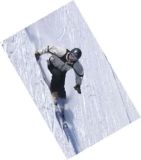
Having read many of the posts about ?How to carve? I felt duty bound to contribute my sixpence worth. I should point out that perhaps this post is more aimed at those who can carve and wish to find (discuss) innovative ways to convey (teach) others to do so than as in instruction manual for the aspiring, non-carving community. Finally, I apologise in advance to all one legged skiers (and I have been humbled whenever I have had the pleasure of skiing in your company) as most of my points refer to the biped community.
Some definitions first:
Fall-line ? This is the path that a ball will follow when rolled down a slope. (Science bit caveat: If the ball did not exhibit the properties of momentum)
Outside ski ? (only applicable when turning) ? This is the ski farthest away from the imaginary centre of the arc made by the skis. For clarity, when making a turn to the right, the left ski will be the outside ski. The outside, and its counterpart the inside ski, will continue to be referred to as such until a turn is complete and the skis are allowed to run straight. The inside and outside skis will be known as such regardless of their position relative to the fall-line.
Turning radius ? The theoretical distance between the centre of the ski and the centre of the arc described by the ski when in reverse camber (i.e. when carving). During a single turn the actual radius of the turn may vary from the start of the turn until the finish and at any point during the turn between the inside and outside ski.
Phew, that?s way too much like a science lesson for me, but sometimes the obvious are only that when expressed!
So what about carving ?
There is one fact that I feel gets overlooked in almost every account I have read about the ?mystical? art of carving. What is this fact? (Remembering my initial apology) ? Most of us are fortunate enough to ski with two legs! Why then do almost all descriptions of carving fail to discuss this essential point? For those who have ?mastered? carving, you may never have considered this point before. I noticed one of the posters here says that ?It?s not a turn if your hand?s not in the snow?, now leaving aside skiing in chest high champagne powder, how would this look on a corduroy piste at 08:01? You can imagine the shape of the skier, upper body slightly inclined towards the inside of the turn, waist laterally flexed to near its maximum, inner knee flexed nearly to it?s fullest and the outer leg very nearly (but not quite) straight. Now imagine freezing that image and rotating it so that the thighs were upright. What you would see would be a skier with one knee lifted right up as if trying to step forward onto a very high step.
So how does this huge difference between leg actions get translated into effective descriptions of carving? Well as the speed of skier reduces and the forces reduce the differences becomes less obvious to the point where, as a description of the carving process, the temptation is to treat both legs as one. IMHO this is the root cause of confusion in teaching carving - not addressing the importance of ?Independent Leg Action?.
So now we have two, independent legs both performing different actions at different points during a turn we have a much better chance of describing the actions required to make the ski carve!
Many of the descriptions of carving I have read concentrate on the importance of inclining and weighting the (future) outside ski to initiate the turn. I find this results in skiers who ?A? frame. Typically, they will create some form of non-skidding action with the outside ski but as they lack the speed or confidence to truly create a carving action that they can rely on, the inner ski will be flattened, rotated and skidded so that the lack of centripetal (centrifugal) force which would have them fall into the turn is balanced by their supporting (inner) leg. Having repeated this action over and over the resulting muscle memory is far harder to correct than the relatively simple action of carving requires.
So I believe that it is more successful when trying to create a mental image of the activity for a non-carving skier to give the following direction:
1. Buy, borrow, rent or beg for some ?carving? skis. (a.k.a. parabolic, shaped or wasted). As an aside, I think it?s possible to carve ?almost? any ski but to learn it definitely easier on skis designed for the purpose.
2. Find a gentle, consistent gradient slope of at least 10m width. The longer the better. The smoother the surface the better. Ideally a straight run from top to bottom should not produce a speed beyond the skier?s ability to control.
3. From a standstill aim directly down the fall-line.
4. Allow yourself to glide down the slope in a straight line with equal weight on both feet. Ankles, knees and hips should be gently flexed. Upper body gently forward. Hands forward, arms relaxed. Poles (if used) pointing behind with tips converging.
5. Now start to move one knee (let?s say the right knee) to the right. Immediately the knee starts to move, think about increasing the weight on the small toe of the right foot. This will have the effect of edging the inside edge of the inside ski (?Horror!!?). At this point you will need to ?soften? or relax the right leg to start to create that essential independent leg action where the right leg is flexed more than the left. Now, to avoid this situation (skiing on the inside edge) becoming terminal, start to bring the left knee across towards the right knee and think about weighting the left big toe.
6. Both skis should now be rotated about their longitudinal axis i.e. edged and your weight should be centred over the ski. You are carving!!!
7. Before turning entirely up the slope and losing the little bit of speed you have, soften the left (outside) leg and move the left knee to the left (inside of the new turn), weight the left little toe and continue as above.
It has been my experience that by making the learners focus on the inside leg and ski ?A? framing never (or very rarely) happens. The progression from here is to work to minimise the inner knee initiation but to continue to make that your focus.
Now as speed, confidence and conditions allow you will be able to increase the lower leg inclination to the slope, which will require you to increase the difference between the actions of each leg and you will start to emulate those glossy marketing brochures! Who knows you may even be able to make turns with sufficient dynamic balance to allow you to ?Touch the Snow!?.
In reality, there are many more subtleties involved in developing the carving action from my first description to the ultimate ?carve anywhere? technique but my focus in this post is to develop the concept of independent leg action and to think about inner leg initiation. Discuss!
Cheers
Jan
The imagery of carving
LoginTo Create or Answer a Topic
Started by Jan I Stenmark in Ski Technique 29-Aug-2007 - 6 Replies
Jan I Stenmark posted Aug-2007
Ellistine
reply to 'The imagery of carving' posted Aug-2007
Jan, I couldn't agree more.
I spend the majority of my time skiing on a plastic dry slope. I also spend the majority of my time carving on said dry slope as performing nice neat skidded turns (especially in the summer when the surface expands to form ripples) is nigh on impossible.
The downside to carving on dryslope is there is nothing much to pressure against and they're a little bit shorter and narrower than your average alpine piste. What this means is that you can't just sit and wait till you've built up enough speed and then throw your hips across the skis hoping that there'll be enough momentum and centrifugal force to keep you up right. Instead you have to accurately roll both skis at the same time to the same angle and do that pretty much as soon as you push off from the start.
My breakthrough was to think only of my inside leg when initiating the turn. If I want to carve to the left, I pull my left knee to the left. Granted, there is probably more going on than that but that's the one thing I consciously think of when initiating a carve turn. The outside leg and ski always seems to take care of themselves.
The other thing I've found using this method is that you get the most amazingly smooth transitions from turn to turn. As you approach the end of one turn, simply ease the pressure on the outside ski (which is about to become the inside ski) and start to point it towards the new turn. This enables you to maintain a lower dynamic stance throughout the transition (starting to sound like Warren Smith!)
I read an article somewhere that recommended the following when carving for the first time;
Forget about pole plants, forget about weighting one ski or the other, just ski in a good balanced position on a nice easy slope. Roll the right knee to create a right turn; roll the left knee to turn left. Don't worry about the other knee; just let if follow along on its own. You won't split in half!
I spend the majority of my time skiing on a plastic dry slope. I also spend the majority of my time carving on said dry slope as performing nice neat skidded turns (especially in the summer when the surface expands to form ripples) is nigh on impossible.
The downside to carving on dryslope is there is nothing much to pressure against and they're a little bit shorter and narrower than your average alpine piste. What this means is that you can't just sit and wait till you've built up enough speed and then throw your hips across the skis hoping that there'll be enough momentum and centrifugal force to keep you up right. Instead you have to accurately roll both skis at the same time to the same angle and do that pretty much as soon as you push off from the start.
My breakthrough was to think only of my inside leg when initiating the turn. If I want to carve to the left, I pull my left knee to the left. Granted, there is probably more going on than that but that's the one thing I consciously think of when initiating a carve turn. The outside leg and ski always seems to take care of themselves.
The other thing I've found using this method is that you get the most amazingly smooth transitions from turn to turn. As you approach the end of one turn, simply ease the pressure on the outside ski (which is about to become the inside ski) and start to point it towards the new turn. This enables you to maintain a lower dynamic stance throughout the transition (starting to sound like Warren Smith!)
I read an article somewhere that recommended the following when carving for the first time;
Forget about pole plants, forget about weighting one ski or the other, just ski in a good balanced position on a nice easy slope. Roll the right knee to create a right turn; roll the left knee to turn left. Don't worry about the other knee; just let if follow along on its own. You won't split in half!
Edited 1 time. Last update at 29-Aug-2007
Jan I Stenmark
reply to 'The imagery of carving' posted Aug-2007
ellistine, you must either be very rich or sponsored by a base repair company to spend your summer months carving on plastic - don't you just love the smell of burning bases??
As for the theory bit you are so right that the other leg just joins in :) My only observation is that I feel that this is a great visualisation aid for the first time carver (is that a word?) but would probably expect the technique to mature to a more two footed (knee'd) style after a few weeks (on snow).
I have seen some very exaggerated examples of carving on plastic which involve the (normally young) skier canting their knees over to extreme angles to force the skis to carve but in the process the lower leg loses its straightness which can lead to all kinds of knee problems in the developing body, not to mention a near total loss of skeletal balance / strength. (Although it is fun to watch the same skier on their first run on snow at the annual race camp!)
I am sure you don?t fall into this category but I bet you?ve seen the ones I mean!
Be safe
Jan
As for the theory bit you are so right that the other leg just joins in :) My only observation is that I feel that this is a great visualisation aid for the first time carver (is that a word?) but would probably expect the technique to mature to a more two footed (knee'd) style after a few weeks (on snow).
I have seen some very exaggerated examples of carving on plastic which involve the (normally young) skier canting their knees over to extreme angles to force the skis to carve but in the process the lower leg loses its straightness which can lead to all kinds of knee problems in the developing body, not to mention a near total loss of skeletal balance / strength. (Although it is fun to watch the same skier on their first run on snow at the annual race camp!)
I am sure you don?t fall into this category but I bet you?ve seen the ones I mean!
Be safe
Jan
Ellistine
reply to 'The imagery of carving' posted Aug-2007
Yes my bases have seen better days but the skis were only £50 from ebay and will probably last me the summer - then I'll probably be on the look out for my next pair of bargain carvers. The ironic thing is, they tend to run better with a good bit of base burn and a squirt of silicone than when they were still receptive to wax!
I did start a thread a while ago about whether or not to use your own skis on a dry slope. The answer is deffinately no if you ever want to use them on snow. Luckily I decided not to use my propper skis on the dry slope.
At the weekend I spent a couple of hours at the Snowdome and was relieved that my dry skiing transfered to 'almost' snow skiing - just faster!
I did start a thread a while ago about whether or not to use your own skis on a dry slope. The answer is deffinately no if you ever want to use them on snow. Luckily I decided not to use my propper skis on the dry slope.
At the weekend I spent a couple of hours at the Snowdome and was relieved that my dry skiing transfered to 'almost' snow skiing - just faster!
Ellistine
reply to 'The imagery of carving' posted Aug-2007
Trencher
reply to 'The imagery of carving' posted Aug-2007
Jan
Your meathod sounds like a great way to engage the inside ski. Imho, using inside leg is the key to powerful carving. Interestingly, inline skate intruction focuses on applying weight to the inside skate from the 101 class and this helps to get the inside leg out from under the skater (it's funny that skidded turns are a more advanced turn on skates).
The reference to hands on the snow in my sig is tounge in cheek. I realise the are many types of turn and reaching for the snow would make a bad habbit. As Pav uses his poles as feelers to gauge his relationship to the snow, as an alpine snowboarder, I'm more used to using my hands to perform this function. That said, nothing is cooler than feeling the corderoy skimming beneath your palm. On a good crisp day, the heat generated will warm your hands up nicely (and burn out your gloves).
Trencher

Your meathod sounds like a great way to engage the inside ski. Imho, using inside leg is the key to powerful carving. Interestingly, inline skate intruction focuses on applying weight to the inside skate from the 101 class and this helps to get the inside leg out from under the skater (it's funny that skidded turns are a more advanced turn on skates).
The reference to hands on the snow in my sig is tounge in cheek. I realise the are many types of turn and reaching for the snow would make a bad habbit. As Pav uses his poles as feelers to gauge his relationship to the snow, as an alpine snowboarder, I'm more used to using my hands to perform this function. That said, nothing is cooler than feeling the corderoy skimming beneath your palm. On a good crisp day, the heat generated will warm your hands up nicely (and burn out your gloves).
Trencher
because I'm so inclined .....
Edited 4 times. Last update at 30-Aug-2007
Pavelski
reply to 'The imagery of carving' posted Aug-2007
Trencher,
Just yesterday I was mentioning to Jan about the "interesting" skiers we have on this site. This was to indicate how "we" are very much individuals with our own minds and opinions. Yet we respect each other and can be civil! Rare are such internet interactions!
Perhaps the excellent administration of this site has something to do with this!
Thus introductions are in order.
Jan and you are , I am sure going to have many spirited discussions. Enjoy the mental jousting!
I see new pict of your no poles technique!!!!
By the way, I will be in Utah for 2 months in 2008. I would love to see you in action. Perhaps can organize a "professional conference" so that Jan, Mike and etc... can meet.
PS
Jan, the other "interesting" fellow yu shouls meet is Mike from NS. He is also an engineer who is designing a fully automated waxing mat which waxes as you line up for the lift!
He also is designing for me a device which can keep my hammock swinging continously so I do not have to ask kids to push me!
So Mike and Trencher you are warned, this man Jan is a challenge ( PS he also skis on Atomics so he has great taste)!
Trencher, are you still interested in the tuning course? You see Jan well be attending so with both of you in class I will have to "up-grade" my class notes, increase the formative tests and create more "imaginative" homework projects.
There are 10 questions all students are supposed to answer BEFORE entering into cyber class! See tuning section!!
Cheers
Just yesterday I was mentioning to Jan about the "interesting" skiers we have on this site. This was to indicate how "we" are very much individuals with our own minds and opinions. Yet we respect each other and can be civil! Rare are such internet interactions!
Perhaps the excellent administration of this site has something to do with this!
Thus introductions are in order.
Jan and you are , I am sure going to have many spirited discussions. Enjoy the mental jousting!
I see new pict of your no poles technique!!!!
By the way, I will be in Utah for 2 months in 2008. I would love to see you in action. Perhaps can organize a "professional conference" so that Jan, Mike and etc... can meet.
PS
Jan, the other "interesting" fellow yu shouls meet is Mike from NS. He is also an engineer who is designing a fully automated waxing mat which waxes as you line up for the lift!
He also is designing for me a device which can keep my hammock swinging continously so I do not have to ask kids to push me!
So Mike and Trencher you are warned, this man Jan is a challenge ( PS he also skis on Atomics so he has great taste)!
Trencher, are you still interested in the tuning course? You see Jan well be attending so with both of you in class I will have to "up-grade" my class notes, increase the formative tests and create more "imaginative" homework projects.
There are 10 questions all students are supposed to answer BEFORE entering into cyber class! See tuning section!!
Cheers
Topic last updated on 09-October-2007 at 09:55